Exotic interactions uncovered in actinide systems
The six orbital phase changes around the internuclear axis are unique to phi interactions. LANL image.
At its most basic level, bonding in actinide molecules is typically comprised of a small amount of covalent orbital mixing in the presence of overwhelming ionic attractions.
“Until recently, few experimental techniques were available to provide quantitative information regarding the extent of covalent bonding for actinides in a range of oxidation states and ligand field environments,” says Stosh Kozimor of the Los Alamos National Laboratory. (Full Story)
World’s space agencies unite to save planet Earth
LANL asteroid video.
The plan aims to create an International Asteroid Warning Network so countries can share what they know about asteroids.
Research scientist Robert Weaver, from the laboratory, has been studying the effects of detonations on asteroids since 2012 and has simulated explosions using the Energy Department’s Cielo supercomputer. (Full Story)
New ideas, technologies from LANL could boost region’s economy
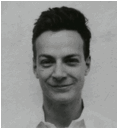
Richard Feynman's Manhattan Project badge photo. LANL image.
The Northern New Mexico annual economy will grow by $2 billion in the next decade if Los Alamos National Laboratory can realize an ambitious vision for converting its stream of new ideas and technologies into world-changing solutions.
“We’re going to be rebranding, remaking and repositioning the division of technology transfer as a whole new topic at Los Alamos,” said David Pesiri, who leads the tech transfer effort at the lab. (Full Story)
New strategy helps Santa Fe Innovation Park land project funding
The Santa Fe Innovation Park is heralding the early success of three projects that could transform Santa Fe.
The Microgrid Systems Lab, which has about a dozen partners and supporters, started about 18 months ago to work on microgrid technology. The lab received $30,000 from Los Alamos National Security to develop its initial technology. (Full Story)
LANL Foundation offers $1,000 awards for NNM residents wanting to return to college
Northern New Mexicans wanting to return to college for a certificate or two-year program are eligible for $1,000 awards from the Regional College/Returning Student program of the Los Alamos Employees’ Scholarship Fund.
Funding for the Los Alamos Employees’ Scholarship Fund comes from contributions by LANL employees and a match from Los Alamos National Security, LLC. (Full Story)
To subscribe to Los Alamos Report, please e-mail listmanager@lanl.gov and include the words subscribe losalamosreport in the body of your email message; to unscubscribe, include unsubscribe losalamosreport.
Please visit us at www.lanl.gov
And follow us on Facebook, Twitter, YouTube, and Flickr
LANL team’s HIV vaccine shows promise in monkeys
A vaccine bioinformatically optimized for immunologic coverage of global HIV diversity, called a mosaic vaccine, may confer protection from infection.
It is designed by Bette Korber and her team at the Los Alamos National Laboratory. (Full Story)
Study: LANL vaccine cuts HIV by 90%
Bette Korber. LANL Photo.
A vaccine developed at Los Alamos National Laboratory has led to a study that resulted in a 90 percent reduction in HIV infections in monkeys, offering researchers a promising new approach for preventing HIV/AIDS in people.
The vaccine, developed from computer models developed by a team led by Bette Korber, a laboratory fellow at LANL, was tested by researchers at Harvard University and Beth Israel Deaconess Medical Center in Boston.
This story also appeared in the Santa Fe New Mexican, Albuquerque Business First, Los Alamos Monitor, KSFR radio and many more news outlets and sources
Technologies to characterize natural gas emissions tested in field experiments
Aircraft overflight of the methane and meteorological sensing towers. LANL/JPL photo.
A new collaborative science program is pioneering the development of ultra-sensitive methane-sensing technology.
"Given the importance of methane to global climate change, this study is essential," said Manvendra Dubey of Los Alamos National Laboratory "This work aids both commercial and government sectors in an effort to better understand and mitigate fugitive methane emissions."
"A significant part of understanding Man's role in global climate change is the accurate measurement of the components that have a profound effect on climate," he said. (Full Story)
Also from PhysOrg this week
3-D Earth model more accurately pinpoints explosions

A one-dimensional velocity profile with depth plotted within a three-dimensional Earth.
LANL's role is the data accumulation from the ground-based nuclear detonation detection research database for ground-truth events (seismic events where we know the location to some specific uncertainty).
Los Alamos provides Sandia the data to use for the tomography model (approximately ten million ray paths from approximately 13,000 distinct seismic stations and approximately 122,000 distinct events), Sandia runs their tomography code to produce the 3-D velocity model and then LANL takes the final model and runs tests to validate how well the model performs. (Full Story)
This story also appeared in Albuquerque Business First
Los Alamos National Laboratory announces dramatic improvements in QD technology
Postdoctoral researcher Young-Shin Park characterizing emission spectra of LEDs. LANL photo.
Dramatic advances in the field of quantum dot light emitting diodes (QD-LEDs) could come from recent work by the Nanotechnology and Advanced Spectroscopy team at Los Alamos National Laboratory.
“QD-LEDs can potentially provide many advantages over standard lighting technologies, such as incandescent bulbs, especially in the areas of efficiency, operating lifetime and the color quality of the emitted light,” said Victor Klimov of Los Alamos. (Full Story)
Physics lectures set for 4 locations
Vincenzo Cirigliano. LANL photo.
The final Frontiers in Science lecture is scheduled with a focus on the question of why matter and antimatter particles didn’t all destroy each other, leaving an empty universe after the Big Bang.
Vincenzo Cirigliano from the Nuclear and Particle Physics, Astrophysics and Cosmology section of Los Alamos National Laboratory will present the talks, all at 7 p.m., at four different locations in November. (Full Story)
Also from the Monitor this week
2014 LANL giving campaign kicks off
The Los Alamos National Laboratory kicked off its 2014 employee giving campaign with a car show Wednesday near TA-3.
A 1939 Buick convertible, which received the Director’s Choice Award. That car is owned by Ken Uher of LANL’s Weapons Facilities Operations Division. The campaign runs through Nov. 27 and it coincides with the United Way of Northern New Mexico campaign. (Full Story)
To subscribe to Los Alamos Report, please e-mail listmanager@lanl.gov and include the words subscribe losalamosreport in the body of your email message; to unscubscribe, include unsubscribe losalamosreport.
Please visit us at www.lanl.gov
And follow us on Facebook, Twitter, YouTube, and Flickr
Solar ‘gardens’ let communities share renewable power
Solar array at UNM Taos. UNM Photo.
In northern New Mexico the sun shines nearly every day of the year. If solar energy is going to be viable anywhere, it will be here—and a small electric cooperative in historic Taos is taking advantage of it. Kit Carson Electric Cooperative is offering its customers the opportunity to buy solar energy from “plots” in a “garden” of solar power generation.
The cooperative has solar power projects with Los Alamos National Laboratory, beginning with a project that provides electric energy for the Taos campus of the University of New Mexico. (Full Story)
A golden anniversary for space-based treaty verification
Richard Belian performs a final check of the Vela V-B satellite prior to its launch. LANL photo.
Fifty years ago this month, Los Alamos National Laboratory sensor technology lifted off into space to help verify that world Superpowers were abiding by the newly signed Limited Test Ban Treaty-a pledge by the United States, the former Soviet Union and the United Kingdom to refrain from testing nuclear weapons in the atmosphere, underwater or in space.
"For the past 70 years, Los Alamos National Laboratory has serviced the country and provided technical solutions to the some of biggest national security challenges facing the nation," said Terry Wallace, Principal Associate Director for Global Security at Los Alamos. (Full Story)
This story also appeared in Hispanic Business
LANL wins 4 NNSA awards
Dennis Hjeresen received a best-in-class award. LANL photo.
The National Nuclear Security Administration (NNSA) Tuesday announced that it has awarded 18 Sustainability Awards for innovation and excellence to its national laboratories and sites.
Los Alamos National Laboratory won four awards for work in DNA, greenhouse gases, environmental sustainability and energy management. (Full Story)
Nanoscale engineering boosts performance of quantum dot light emitting diodes
The quantum dot device structure. LANL image.
Dramatic advances in the field of quantum dot light emitting diodes (QD-LEDs) could come from recent work by the Nanotechnology and Advanced Spectroscopy team at Los Alamos National Laboratory.
Quantum dots are nano-sized semiconductor particles whose emission color can be tuned by simply changing their dimensions. They feature near-unity emission quantum yields and narrow emission bands, which result in excellent color purity. (Full Story)
Nanostructures offer way to control quantum effect
Researchers measured the Casimir attraction between a metallic grating and a gold coated sphere. NIST image.
Prevailing theory does a good job describing the Casimir force between featureless, flat surfaces and even between most smoothly curved surfaces. However, according to researchers existing theory fails to predict the interactions they observed in their experiment.
This work was performed in collaboration with scientists from Los Alamos National Laboratory; the Univ. of Maryland, College Park; Argonne National Laboratory; and Indiana Univ. – Purdue Univ. (Full Story)
Nuclear cleanup project could be model for other sites
 Kurchatov city, center of the Semipalatinsk nuclear test site. From NTI.
A Soviet-era nuclear test site in Kazakhstan was cleaned up through a collaborative international project that could provide lessons for tackling other dangerous nuclear sites across the globe
Nuclear scientists from Los Alamos National Laboratory, a US nuclear research institution, first met their Kazakh and Russian counterparts in 1992 following the Soviet Union’s collapse. (Full Story)
To subscribe to Los Alamos Report, please e-mail listmanager@lanl.gov and include the words subscribe losalamosreport in the body of your email message; to unscubscribe, include unsubscribe losalamosreport.
Please visit us at www.lanl.gov
And follow us on Facebook, Twitter, YouTube, and Flickr
How the Earth works
Cathy Plesko works with some of the world’s most powerful supercomputers at Los Alamos National Laboratory. You can almost imagine a T-Rex out there, can’t you? Ah, you really can.
Cathy's going to show me a highly accurate simulation of the impact. And it reveals how a wave of death spread from here in the Gulf of Mexico right the way around the world. (Watch Here)
Former enemies sign agreement to work on nuclear weapons to tackle the danger of asteroids
Los Alamos computer model of an asteroid detonation. LANL image.
The two countries were once at loggerheads over the use of nuclear warheads, but now the U.S. and Russia have joined forces to develop the technology together - and the partnership could one day lead to weapons being used to destroy asteroids hurtling towards earth.
Research scientist Robert Weaver, from Los Alamos National Laboratory, has been studying the effects of detonations on asteroids since 2012 and has simulated explosions using the Energy Department’s Cielo supercomputer. (Full Story)
Los Alamos researcher: Ocean temps may delay region’s disaster
LANL climatologist Petr Chylek. LANL image.
Scientists worldwide agree the climate is changing, global temperatures are warming, the Arctic ice is melting and humans are a primary cause. But don’t panic — yet — if you live in the Southwestern United States, says a team of Los Alamos National Laboratory climatologists.
The next five years will determine whether the Southwest keeps on its hotter, drier path or enjoys a reprieve with some increased precipitation, according to the LANL research team headed by Petr Chylek. (Full Story)
Sky survey captures stunning details of two new cosmic explosions
The Palomar Observatory. Cal Tech image.
Astronomers using the intermediate Palomar Transient Factory (iPTF) began observing the skies for certain types of stars and related phenomena in February of this year.
Since its inauguration, iPTF has been tremendously successful in the early discovery and rapid follow-up studies of transient objects, and two recent papers by iPTF astronomers illustrate first-time detections
The iPTF is a scientific partnership between Caltech; Los Alamos National Laboratory; the University of Wisconsin, Milwaukee; the Oskar Klein Centre in Sweden; and others. (Full Story)
History buff’s gift will help tell the story of Los Alamos
The late Harold Agnew at a 2012 colloquium. LANL image.
Clay Perkins and his wife, Dorothy, made public a $530,000 donation to the Los Alamos Historical Society that will significantly expand that group’s exhibition space and its efforts to describe the history of the Atomic City.
The Bethe House, as the 1350 Bathtub Row residence is known, will house the Harold Agnew Cold War Museum, named after the physicist and former LANL director who died last month. (Full Story)
Also from the ABQ Journal this week:
Atomic bomb has Italian family, New Mexican roots

Enrico Fermi at the University of Chicago in 1946. From the Journal.
July 16, 1945. The first nuclear device had just exploded. It consisted of an overwhelming light illuminating the mountains all around, and a mushroom cloud rising into the bright desert sky.
Among the scientists attending the detonation was Enrico Fermi. Italian-born and worldwide-celebrated physicist, he had fled from Italy to save his family from the fascist racial persecutions. (Full Story)
To subscribe to Los Alamos Report, please e-mail listmanager@lanl.gov and include the words subscribe losalamosreport in the body of your email message; to unscubscribe, include unsubscribe losalamosreport.
Please visit us at www.lanl.gov
And follow us on Facebook, Twitter, YouTube, and Flickr