Friday, July 16, 2021


Why the U.S. once set off a nuclear bomb in space

Artificial aurora created by the Starfish Prime nuclear test in 1962, from NatGeo.


In the unlikely event another nuclear bomb goes off in space, Geoff Reeves, a research fellow at Los Alamos National Laboratory in New Mexico, has been working on a quick way to get rid of radiation belts made from nuclear blasts. In his design, a transmitter mounted on a satellite hits the trapped radiation with specialized AM radio waves, which nudge the charged particles lower into the atmosphere, where they would be harmlessly absorbed.


“So now, if you had a Starfish belt and you had the right technology in space,” Reeves says, “you could get rid of that belt in a couple of weeks.” (Full Story)


LANL joins effort to track bird-borne pathogens with pandemic potential
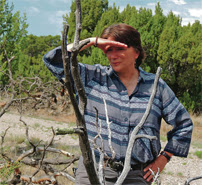
 

Ornithologist Jeanne Fair, New Mexican photo.


Migratory birds can fly great distances, enabling them to spread an infectious disease to far-flung areas of the world.


Los Alamos National Laboratory is supplying its expertise in genetic research to a consortium that will study birds migrating along a flyway stretching from Africa across the Mediterranean and Black seas to the Arctic, in part as a pandemic-prevention effort.


Named the Avian Zoonotic Disease Network, the consortium seeks to detect bird-borne illnesses — especially ones with pandemic potential — to better understand how they originate, how they can be transferred to livestock and people, and how to prevent their spread. (Full Story)


For the birds


Jeanne Fair and feathered friend, LANL photo.


In early June, China reported a 41-year-old man had been infected with H10N3—a type of avian influenza—marking the first case of human infection from that particular strain.  For scientists like Jeanne Fair, the event emphasizes the fortuitous timing of a new initiative kicking off this fall: the Avian Zoonotic Disease Network.


A scientist with Los Alamos National Laboratory’s Biosecurity and Public Health division, Fair’s career has focused on epidemiology and animal disease ecology. As part of that work, she spent three years as the regional science manager in the Middle East and Central Asia region for the US Department of Defense’s Biological Threat Reduction program, which is supplying the grant for the new avian project. (Full Story)


Neutron-clustering effect in nuclear reactors demonstrated for first time


Nicholas Thompson helps to set up the neutron clustering measurements at Rensselaer Polytechnic Institute, LANL photo.


For the first time, the long-theorized neutron-clustering effect in nuclear reactors has been demonstrated, which could improve reactor safety and create more accurate simulations, according to a new study recently published in the journal Nature Communications Physics.


"The neutron-clustering phenomenon had been theorized for years, but it had never been analyzed in a working reactor," said Nicholas Thompson, an engineer with the Los Alamos Advanced Nuclear Technology Group. "The findings indicate that, as neutrons fission and create more neutrons, some go on to form large lineages of clusters while others quickly die off, resulting in so-called 'power tilts,' or asymmetrical energy production." (Full Story)


Also from the Los Alamos Reporter


D-Wave, Los Alamos isolate emergent magnetic monopoles using quantum-annealing computer


Testbed to examine the behavior of emergent magnetic monopoles. LANL graphic.


Using a D-Wave quantum-annealing computer as a testbed, scientists at Los Alamos National Laboratory have shown that it is possible to isolate so-called emergent magnetic monopoles, a class of quasiparticles, creating a new approach to developing “materials by design.”


“We wanted to study emergent magnetic monopoles by exploiting the collective dynamics of qubits,” said Cristiano Nisoli, a lead Los Alamos author of the study. “Magnetic monopoles, as elementary particles with only one magnetic pole, have been hypothesized by many, and famously by Dirac, but have proved elusive so far.” (Full Story)


Also from the Los Alamos Reporter


Will DeltaFS become the file system of Exascale's future?


Los Alamos National Lab storage and HPC leads, Gary Grider and Brad Settlemyer are well known in the world of supercomputing I/O with innovations ranging from burst buffers, computational storage, file system enhancements and more. They have been developing the new exascale file system, dubbed DeltaFS, in conjuction with the Parallel Data Lab at Carnegie Mellon (with PanFS creator, Garth Gibson) among other institutions. This lends the effort some serious credibility of the gate and the open source approach further solidifies the potential role of DeltaFS in some upcoming extreme-scale HPC environments. (Full Story)


Also from Next Platform this week:


QCI bridging quantum, classical divide at Los Alamos


Sue Mniszewski has been a research staff member at Los Alamos National Lab (LANL) for over forty years and in that time has watched several novel architectures come and go.


LANL was one of the first sites to install a D-Wave quantum annealing machine and also has access to other quantum offerings through the various cloud interfaces of IBM and others. But for Mniszewski, the hardware is not the interesting part of the conversation just now, it’s seeing just how quickly she sped through toy problems on early devices—blowing past the capabilities of current limited-qubit machines. (Full Story)


LANL Exascale computer cooling project earns DOE Secretary’s Award


Piping installed as part of the Exascale Class Computer Cooling Equipment Project, LANL photo.


The winning ECCCE team successfully completed a project to bring 5,200 tons of cooling capacity to support new exascale computing equipment in the Strategic Computing Complex at Los Alamos National Laboratory (LANL). The project was executed within a secure classified facility and was required to minimize disruption of ongoing operations. Led by NNSA’s John Gallegos, the team completed this project $20 million under budget and 10 months ahead of schedule.


These awards are a testament to NNSA’s commitment to project excellence whose policies and organizational realignment in 2012 has successfully completed over $2.5 billion in projects under budget and on schedule. (Full Story)


To subscribe to Los Alamos Press Highlights, please e-mail listmanager@lanl.gov and include the words subscribe PressHighlights in the body of your email message; to unsubscribe, include unsubscribe PressHighlights.


Please visit us at www.lanl.gov

Thursday, July 8, 2021

The solar wind bubble that protects Earth has been mapped for the first time

Image credit: NASA


In 2009, using NASA’s Interstellar Boundary Explorer, also known as IBEX, astronomers spied a strange ribbon-like structure dancing between our solar system and the rest of interstellar space.


The discovery of the IBEX Ribbon, which is invisible to both telescopes and the human eye, was one of scientists’ first forays into understanding more about our heliosphere—a bubble-like shield made up of solar winds. 


A new study published in the Astrophysical Journal maps the entire boundary of this shield, and the data collected may be used to usher in a new era of heliophysics exploration.


“Most instruments that detect particles in space are detecting charged particles,” says Daniel Reisenfeld, a senior scientist at Los Alamos National Laboratory in New Mexico and lead author of the study. But IBEX is unique. (Full Story)


New Open-Source Software Checks Quantum Annealers, Including Noise and Qubits


Researchers from the Los Alamos National Laboratory have developed new open-source software that could evaluate quantum annealers down to the individual qubit level aside from also characterizing noise. 


Usually, when institutions and organizations purchase a new piece of equipment, such as a classical supercomputer, this new item is first verified and validated. It involves running the equipment against a set of benchmarks. This drove the team of Carleton Coffrin, a computer scientist and artificial intelligence expert, to develop open-source software that could do a similar job, but this time for quantum annealers.


"We didn't have good analogs for that on the quantum annealing computers. For quantum annealing, our new a Quantum Annealing Single-qubit Assessment, or QASA, protocol gives us one tool for acceptance testing," Coffrin said of their new project. The Los Alamos National Laboratory team published the report "Single-Qubit Fidelity Assessment of Quantum Annealing Hardware" on the latest IEEE Transactions on Quantum Engineering. (Full Story)


NASA’s ‘Lucy’ mission featured at Los Alamos ScienceFest


Image credit: NASA


Even as the Mars Rover is exploring our closest neighboring planet, NASA is preparing a mission bound for farther reaches of our solar system.


Discussing the upcoming “Lucy” mission to Jupiter’s Trojan asteroids is one of the highlights of this coming week’s annual Los Alamos ScienceFest, which runs through next Sunday. (Full Story)


LANL's growth means opportunity for Northern New Mexico


Kelly Beierschmitt, Deputy Director Operations at LANL.


Many of you reading this have probably already heard that Los Alamos will soon open two offices in Santa Fe to help accommodate our growth and changes in the region. The move will benefit many of our employees who live outside of Los Alamos, and it will be a hub for the laboratory’s educational partnerships, workforce development initiatives, government affairs and technology-transfer programs.


The move also highlights our commitment to support the laboratory’s growth with the necessary infrastructure.


Los Alamos is committed to supporting New Mexico’s cities and counties because as they get stronger, so do we. We value being active in our communities and lending a hand when needed — such as donating food, school supplies, blood and time to local organizations. And the laboratory is expanding its efforts to support K-12 and higher education students and institutions through scholarship and employee tuition reimbursement programs. (Full Story)


Friday, July 2, 2021


Supermassive black holes could host giant, swirling gas 'tsunamis'


Visualization shows a supermassive black hole surrounded by dust and gas forming tsunamis on its outer edges.  (Image credit: Space.com, Nima Abkenar)


Could gas escaping the gravitational grasp of supermassive black holes be forming "tsunamis" in space? 


In a new, NASA-funded study, astrophysicists used computer simulations to model the environment around supermassive black holes in deep space. They found that there could be massive, tsunami-like structures forming near these black holes that are essentially massive, swirling walls of gas that have narrowly escaped the intense gravitational pull of the black hole. They even think that supermassive black holes could host the largest tsunami-like structures in the universe. 


"These clouds are 10 times hotter than the surface of the sun and moving at the speed of the solar wind, so they are rather exotic objects that you would not want an airplane to fly through," lead author Tim Waters, a postdoctoral researcher at UNLV who is also a guest scientist at Los Alamos National Laboratory in New Mexico, said in the same statement. (Full Story)


Mapping the world’s longest lightning bolts


Megaflashes can now be identified across the globe with the use of geostationary satellites.


As the summer skies start to roil with thunderstorms, New Mexicans get a front-and-center seat to some spectacular lightning displays. We may even count the time between spotting the flash and hearing the roar, a means to calculate the distance of the lightning that ensures we’re a safe distance from the strike.


In most cases, if the flash of light and clap of thunder are more than 30 seconds apart, it usually indicates enough distance from the storm to avoid being struck. But this applies only to normal thunderstorms that are small and send bolts vertically from the cloud directly to the ground. For one in ten lightning flashes, globally, this is not the case. (Full Story)


Also from the Albuquerque Journal:


LANL working on ‘Million Mile’ truck


LANL scientists are working to improve hydrogen cell technology in a bid to boost efficiency.


The technology is not particularly new, and neither is the idea.


But, using hydrogen as an alternative fuel source via a proton-exchange membrane fuel cell, also known as a polymer electrolyte membrane, is quickly gaining traction. It is something scientists at Los Alamos National Laboratory are looking to make efficient and cost-effective enough to see it used on a large-scale basis, first with long-haul 18-wheelers and eventually with everyday vehicles.


Estimates show that simple conversion of the country’s transportation fleet could cut related greenhouse gasses in the United States by 20 percent. (Full Story)


Why "nuclear batteries" offer a new approach to carbon-free energy


Cut-away rendering of the MIT nuclear battery concept. Courtesy photo.


How do we know that these new kinds of reactors will work, and what would need to happen for such units to become widely available?


NASA and Los Alamos National Laboratory demonstrated a microreactor for space applications in three years (2015-2018) from the start of design to fabrication and testing. And it cost them $20 million, leveraging the available Department of Energy nuclear technology infrastructure. This cost and schedule are orders of magnitude smaller than for traditional large nuclear plants that easily cost billions and take between five years and a decade to build. (Full Story)


NASA marks 60 years of nuclear 

power in space

Image credit: NASA


NASA has marked the 60th anniversary of the launch into space of its first nuclear-powered satellite. Transit IV-A - an experimental navigational satellite with a radioisotope-powered generator - was launched by Johns Hopkins University Applied Physics Laboratory from Cape Canaveral on 29 June 1961, and NASA has since flown more than 25 missions carrying a nuclear power system.


The plutonium-238 fuel used in NASA's radioactive power systems is provided through a partnership with the US Department of Energy (DOE). The isotope is made by irradiating neptunium-237, and is currently produced by Oak Ridge National Laboratory in partnership with Idaho and Los Alamos National Laboratories. (Full Story)