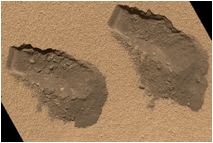
Water for future Mars astronauts?
Two areas on Mars at “Rocknest” that were scooped out by the Curiosity Rover last year. JPL photo.
Within its first three months on Mars, NASA’s Curiosity Rover saw a surprising diversity of soils and sediments along a half-kilometer route that tell a complex story about the gradual desiccation of the Red Planet.
Perhaps most notable among findings from the ChemCam team is that all of the dust and fine soil contains small amounts of water.
“We made this discovery literally with the very first laser shot on the Red Planet,” said Roger Wiens, leader of the ChemCam instrument team. “Every single time we shot at dust we saw a significant hydrogen peak.” (Full Story)
Fusion, anyone? Not quite yet, but researchers show just how close we’ve come
The National Ignition Facility. From LLNL.
The dream of igniting a self-sustained fusion reaction with high yields of energy, a feat likened to creating a miniature star on Earth, is getting closer to becoming reality, according the authors of a new review article in the journal Physics of Plasmas.
The project is a multi-institutional effort including partners from the University of Rochester, General Atomics, Los Alamos National Laboratory, Sandia National Laboratory, and the Massachusetts Institute of Technology. (Full Story)
Event aims to humanize science to lure girls
Ellen Cerreta. LNAL photo.
Ellen Cerreta, a deputy group leader in the Materials Science and Technology Division at Los Alamos National Laboratory, is among the women in science who will conduct workshops for girls in grades five through eight to help expose them to the possibilities of careers in STEM-C (science, technology, engineering, mathematics and computing).
Citing the presence of the national labs in New Mexico, Cerreta said, “There is a tremendous amount of opportunity… for women in this state if they pursue careers in the STEM fields.” (Full Story)
Sandia Biotech gets global distribution and marketing agreement
Sandia Biotech, Inc. has signed a global distribution agreement with Sigma-Aldrich for its Split Fluorescent Protein product line, which is based on technology licensed from Los Alamos National Laboratory.
Sandia Biotech’s sFP technology, which includes several easy-to-use kits that are available in green, yellow and cyan variations, is utilized in protein and peptide analysis by the pharmaceutical drug development and industrial biotech communities. (Full Story)
Photos: 50 years of space
From left to right, Sam Bame, Dick Belian, Jack Fuller, Norm Blocker and Sid Singer at the Bradbury. LANL photo.
Present and former scientists and researchers who worked in LANL’s Vela satellite program commemorate 50 years of Los Alamos National Laboratory treaty verification from space at the Bradbury Science Museum.
In addition to a special Vela-shaped cake, participants enjoyed a presentation by lab associate Morrie Pongratz, who recounted 50 years of contributions to space research and national security programs. (Full Story)
Los Alamos picks three companies for remediation work
Road work at Los Alamos. LANL photo.
Los Alamos National Laboratory has selected three businesses for environmental support services work worth up to $400 million over a five-year period.
The businesses were selected based on a technical proficiency and lowest price basis. The companies — Terranear PMC, Navarro Research and Engineering, Inc. and Portage, Inc. — were chosen from 11 prospective bidders, according to a news release issued by the laboratory. Task orders under this agreement will be awarded based on available funding. (Full Story)
LANL reports damage to monitoring stations
Mortandad canyon showing high water levels after storms. LANL photo.
Los Alamos National Laboratory on Friday reported millions of dollars in damages to environmental monitoring stations around the property, due to recent heavy rain and flooding.
Dave McInroy, the lab’s program director for environmental corrective actions, described last week’s rainfall at the Northern New Mexico as an epic event. (Full Story)

Academia.edu raises funds to build a Facebook for scientists
Startup hopes to overhaul how researchers publish papers, making them freely available to all and substituting social-network success for the traditional peer-review process.
It’s similar to another effort called the LANL Preprint Archive, which launched in 1991 at Los Alamos National Laboratory. That effort grew into Arxiv, which is owned and operated by Cornell University. (Full Story)
To subscribe to Los Alamos Report, please e-mail listmanager@lanl.gov and include the words subscribe losalamosreport in the body of your email message; to unscubscribe, include unsubscribe losalamosreport.
Please visit us at www.lanl.gov
And follow us on Facebook, Twitter, YouTube, and Flickr
 3-D Earth model pinpoints earthquakes, nuclear blasts
 A new 3D model of the Earth will now let scientists pinpoint the sources of earthquakes and explosions around the globe more accurately than ever, researchers say.
The new model of the Earth's mantle and crust from Sandia National Laboratories and Los Alamos National Laboratory is called Sandia-Los Alamos 3D, or SALSA3D. The aim of the model is to more accurately locate all types of explosions, including nuclear ones, for the U.S. Air Force and the international Comprehensive Nuclear-Test-Ban Treaty Organization (CTBTO) in Vienna. (full story)
A reprint of this story also was posted this week in Yahoo! News
A new 3D model of the Earth will now let scientists pinpoint the sources of earthquakes and explosions around the globe more accurately than ever, researchers say.
The new model of the Earth's mantle and crust from Sandia National Laboratories and Los Alamos National Laboratory is called Sandia-Los Alamos 3D, or SALSA3D. The aim of the model is to more accurately locate all types of explosions, including nuclear ones, for the U.S. Air Force and the international Comprehensive Nuclear-Test-Ban Treaty Organization (CTBTO) in Vienna. (full story)
A reprint of this story also was posted this week in Yahoo! News
 Supercomputers: Extreme Computing at the National Labs
Sometimes big science requires big resources. Over the next month, we'll be highlighting one of those big resources -- supercomputers -- on energy.gov.
The Energy Department's National Labs have incredible computational resources, including 32 of the 500 fastest supercomputers in the world. Several of these computers operate at the petascale, or in excess of one quadrillion floating point operations per second. The supercomputers at the National Labs are used to explore everything from the effects of global climate change to astrophysics and quantum mechanics. (full story)
Supercomputers: Extreme Computing at the National Labs
Sometimes big science requires big resources. Over the next month, we'll be highlighting one of those big resources -- supercomputers -- on energy.gov.
The Energy Department's National Labs have incredible computational resources, including 32 of the 500 fastest supercomputers in the world. Several of these computers operate at the petascale, or in excess of one quadrillion floating point operations per second. The supercomputers at the National Labs are used to explore everything from the effects of global climate change to astrophysics and quantum mechanics. (full story)
 Several Key Discoveries During Van Allen Probes First Year
NASA’s twin Van Allen Probes entered their second year of service Friday having already provided a wealth of new information about the layers of energetic charged particles located above our planet.
According to Geoff Reeves, a radiation belt scientist at Los Alamos National Laboratory and first author on a research paper discussing the topic, the agency has “real evidence that the changes originate from within the belts themselves.” (full story)
This story also appeared this week in PhysOrg
Several Key Discoveries During Van Allen Probes First Year
NASA’s twin Van Allen Probes entered their second year of service Friday having already provided a wealth of new information about the layers of energetic charged particles located above our planet.
According to Geoff Reeves, a radiation belt scientist at Los Alamos National Laboratory and first author on a research paper discussing the topic, the agency has “real evidence that the changes originate from within the belts themselves.” (full story)
This story also appeared this week in PhysOrg
 New Evidence to Aid Search for Charge 'Stripes' in Superconductors
Scientists at the U.S. Department of Energy's (DOE) Brookhaven National Laboratory have identified a series of clues that particular arrangements of electrical charges known as "stripes" may play a role in superconductivity-the ability of some materials to carry electric current with no energy loss. But uncovering the detailed relationship between these stripe patterns and the appearance or disappearance of superconductivity is extremely difficult, particularly because the stripes that may accompany superconductivity are very likely moving, or fluctuating.
The scientists ground up crystals of the test material into a fine powder and placed samples of it in line with a beam of neutrons at the Los Alamos Neutron Scattering Center at Los Alamos National Laboratory. Similar to the way light reflecting off an object enters your eyes to create an image, the neutron beams diffracted by the crystals' atoms yield information about the positions of the atoms. The scientists used that information to infer the material's electronic structure, and repeated the experiment at gradually warmer temperatures. (full story)
New Evidence to Aid Search for Charge 'Stripes' in Superconductors
Scientists at the U.S. Department of Energy's (DOE) Brookhaven National Laboratory have identified a series of clues that particular arrangements of electrical charges known as "stripes" may play a role in superconductivity-the ability of some materials to carry electric current with no energy loss. But uncovering the detailed relationship between these stripe patterns and the appearance or disappearance of superconductivity is extremely difficult, particularly because the stripes that may accompany superconductivity are very likely moving, or fluctuating.
The scientists ground up crystals of the test material into a fine powder and placed samples of it in line with a beam of neutrons at the Los Alamos Neutron Scattering Center at Los Alamos National Laboratory. Similar to the way light reflecting off an object enters your eyes to create an image, the neutron beams diffracted by the crystals' atoms yield information about the positions of the atoms. The scientists used that information to infer the material's electronic structure, and repeated the experiment at gradually warmer temperatures. (full story)
 Magnetic charge crystals imaged in artificial spin ice
A team of scientists, led by University of Illinois physicist Peter Schiffer, has reported direct visualisation of magnetic charge crystallisation in an artificial spin ice material, a first in the study of a relatively new class of frustrated artificial magnetic materials-by-design known as "Artificial Spin Ice." These charges are analogues to electrical charges with possible applications in magnetic memories and devices.
Los Alamos National Laboratory staff scientist Cristiano Nisoli explained, "The emergence of magnetic monopoles in spin ice systems is a particular case of what physicists call fractionalisation, or deconfinement of quasi-particles that together are seen as comprising the fundamental unit of the system, in this case the north and south poles of a nanomagnet. We have seen how arranging magnets in a honeycomb configuration allows for these charges to be sort of ‘stripped’ from the magnetic islands to which they belong and become relevant degrees of freedom." (full story)
Magnetic charge crystals imaged in artificial spin ice
A team of scientists, led by University of Illinois physicist Peter Schiffer, has reported direct visualisation of magnetic charge crystallisation in an artificial spin ice material, a first in the study of a relatively new class of frustrated artificial magnetic materials-by-design known as "Artificial Spin Ice." These charges are analogues to electrical charges with possible applications in magnetic memories and devices.
Los Alamos National Laboratory staff scientist Cristiano Nisoli explained, "The emergence of magnetic monopoles in spin ice systems is a particular case of what physicists call fractionalisation, or deconfinement of quasi-particles that together are seen as comprising the fundamental unit of the system, in this case the north and south poles of a nanomagnet. We have seen how arranging magnets in a honeycomb configuration allows for these charges to be sort of ‘stripped’ from the magnetic islands to which they belong and become relevant degrees of freedom." (full story)
 New Insights on Wildfire Smoke Could Improve Climate Change Models
Where there's wildfire, there's smoke--a lot of it. And those vast, carbon-laden clouds released by burning biomass can play a significant role in climate change.
The research was funded by Michigan Tech startup funds, a Michigan Tech Summer Undergraduate Research Fellowship, the National Science Foundation (award number AGS-1028998) and the US Department of Energy (award number DE-SC0006941), with additional support from the Los Alamos National Laboratory and NASA. (full story)
New Insights on Wildfire Smoke Could Improve Climate Change Models
Where there's wildfire, there's smoke--a lot of it. And those vast, carbon-laden clouds released by burning biomass can play a significant role in climate change.
The research was funded by Michigan Tech startup funds, a Michigan Tech Summer Undergraduate Research Fellowship, the National Science Foundation (award number AGS-1028998) and the US Department of Energy (award number DE-SC0006941), with additional support from the Los Alamos National Laboratory and NASA. (full story)
 NMSU Research Rally to celebrate award of $5 million for algae research project
Las Cruces, NM (KDBC) — New Mexico State University will honor Peter Lammers, of the Energy Research Laboratory. Lammers and the NMSU Algal Bioenergy Program team have recently received a grant of $5 million from the Department of Energy for a two-and-a-half year research project, "Realization of Algae Potential.
Lammers will lead a team of partners in this research effort, including researchers at the Los Alamos, Argonne and Pacific Northwest National Laboratories, Washington State University, Michigan State University, and four companies: Phycal, Algenol Biofuels, Pan Pacific Technologies, and UOP-Honeywell. The project involves researchers from New Mexico State's departments of Chemical (Shuguang Deng) and Civil (Nagamany Nirmalakhandan) Engineering, Fishery and Wildlife Sciences (Wiebke Boeing), Plant and Environmental Sciences (Omar Holguin), the Molecular Biology Program (Wayne VanVoorhies) and the Bio-Security and Food Safety Laboratory (Tanner Schaub). (full story)
To subscribe to Los Alamos Report, please send an email and include the words “subscribe losalamosreport” in the body of your email message; to unscubscribe, include “unsubscribe losalamosreport”.
Please visit us at www.lanl.gov
NMSU Research Rally to celebrate award of $5 million for algae research project
Las Cruces, NM (KDBC) — New Mexico State University will honor Peter Lammers, of the Energy Research Laboratory. Lammers and the NMSU Algal Bioenergy Program team have recently received a grant of $5 million from the Department of Energy for a two-and-a-half year research project, "Realization of Algae Potential.
Lammers will lead a team of partners in this research effort, including researchers at the Los Alamos, Argonne and Pacific Northwest National Laboratories, Washington State University, Michigan State University, and four companies: Phycal, Algenol Biofuels, Pan Pacific Technologies, and UOP-Honeywell. The project involves researchers from New Mexico State's departments of Chemical (Shuguang Deng) and Civil (Nagamany Nirmalakhandan) Engineering, Fishery and Wildlife Sciences (Wiebke Boeing), Plant and Environmental Sciences (Omar Holguin), the Molecular Biology Program (Wayne VanVoorhies) and the Bio-Security and Food Safety Laboratory (Tanner Schaub). (full story)
To subscribe to Los Alamos Report, please send an email and include the words “subscribe losalamosreport” in the body of your email message; to unscubscribe, include “unsubscribe losalamosreport”.
Please visit us at www.lanl.gov
Don't forget! Follow us on Twitter, Facebook, YouTube and Flickr!
Magnetic charge crystallization directly visualized in artificial spin ice material
3-D depiction of the honeycomb artificial spin ice topography. UI image.
Los Alamos National Laboratory staff scientist Cristiano Nisoli explained, "The emergence of magnetic monopoles in spin ice systems is a particular case of what physicists call fractionalization, or deconfinement of quasi-particles that together are seen as comprising the fundamental unit of the system, in this case the north and south poles of a nanomagnet." (Full Story)
Homeland Security takes on tech’s ‘Valley of Death’
Death Valley National Park. From BusinessWeek.
PathScan: This project out of Los Alamos National Lab takes a counterintuitive approach. Instead of keeping online attackers out, the software lets them in so it can trace in real time the path of hackers, learn their techniques and pinpoint machines that are likely compromised so technicians can take those offline. The technology is already running on the lab's 20,000-computer unclassified network. (Full Story)
Mystery revealed, weapons vault declassified
FOX correspondent Will Carr and photographer Lloyd Gottschalk. LANL photo.
A crew from the FOX News Channel spent the better part of two days at the Laboratory last week doing a story about the Cold War site, the TA-41 tunnel vault.
The crew interviewed Lab historian Ellen McGehee and toured the site on day one. The next day, Aug. 21, the correspondent, Will Carr, went live with the story throughout the day on FOX News. Carr recently worked at KOAT-TV in Albuquerque. (Watch the video)
Compact, lightweight X-ray scans
LANL MiniMAX. LANL image.
X-ray scanners are, even after decades of development, bulky, heavy, expensive and not always reliable. Los Alamos National Laboratory, with the help of several industry experts in optics, has introduced an x-ray device, MiniMAX that overcomes these limitations. MiniMax (Miniature, Mobile, Agile X-ray system) is light, portable, relatively inexpensive and robust. (Full Story)
Navy tests next generation sequencing to gather DNA information
DNA sequence illustration. From Global Biodefense.
Naval Medical Research Center researchers are working with scientists at the Los Alamos National Laboratory (LANL) to test the deployment of the NGS technology called “Edge Bioinformatics.” NMRC researchers are identifying the logistics required to gather the necessary bioinformatics information, specifically DNA sequence information about thousands of organisms from E. coli to Ebola virus. (Full Story)
New insights on wildfire smoke could improve climate change models
FES electron microscope images of different categories of soot particles. MichTech image.
A Michigan Tech team that includes alumnus Kyle Gorkowski of the Los Alamos National Laboratory, along with other LANL scientists, looked at two types of particles captured during the 2011 Las Conchas fire in New Mexico: soot, not unlike that found in diesel exhaust; and tar balls, tiny round blobs that are abundant in biomass smoke and composed largely of carbon and oxygen. (Full Story)
Los Alamos honors team for work with P&G
Harry Martz, left, and Michael Hamada with their Feynman Prizes. LANL image
Los Alamos National Laboratory has given its first Richard Feynman Prize for Innovation Achievement to researchers at the lab in recognition for their work with Procter & Gamble.
Michael Hamada, Harold Martz and their colleagues worked with Procter & Gamble for years developing a concept known as Reliability Technology — a statistical method that P&G has used to streamline its manufacturing processes. (Full Story)

Record set for LANL scholarship fund
This year’s Los Alamos National Laboratory Employees’ Scholarship Fund broke past fundraising records, raising a total of $563,827.
Scholarship awards went to 73 students in a seven-county region. Winners received their checks, ranging from $20,000 to $1,000 at a recent ceremony at the LANL Foundation office courtyard in Española. (Full Story)
To subscribe to Los Alamos Report, please e-mail listmanager@lanl.gov and include the words subscribe losalamosreport in the body of your email message; to unscubscribe, include unsubscribe losalamosreport.
Please visit us at www.lanl.gov
And follow us on Facebook, Twitter, YouTube, and Flickr
 New Gamma-Ray observatory begins operations at Sierra Negra Volcano
 The High-Altitude Water Cherenkov (HAWC) Gamma Ray Observatory has begun formal operations at its site in Mexico. HAWC is designed to study the origin of very high-energy cosmic rays.
"The HAWC observatory will search for signals from dark matter and to study some of the most extreme objects in the universe, such as supermassive black holes and exploding stars," said Brenda Dingus, principal investigator and a research fellow at Los Alamos National Laboratory. (full story)
Also from PhysOrg this week:
3-D Earth model more accurately pinpoints source of earthquakes, explosions
The High-Altitude Water Cherenkov (HAWC) Gamma Ray Observatory has begun formal operations at its site in Mexico. HAWC is designed to study the origin of very high-energy cosmic rays.
"The HAWC observatory will search for signals from dark matter and to study some of the most extreme objects in the universe, such as supermassive black holes and exploding stars," said Brenda Dingus, principal investigator and a research fellow at Los Alamos National Laboratory. (full story)
Also from PhysOrg this week:
3-D Earth model more accurately pinpoints source of earthquakes, explosions
 Under the sponsorship of the National Nuclear Security Administration's Office of Defense Nuclear Nonproliferation R&D, Sandia National Laboratories and Los Alamos National Laboratory have partnered to develop a 3-D model of the Earth's mantle and crust called SALSA3D, or Sandia-Los Alamos 3D.
The purpose of this model is to assist the US Air Force and the international Comprehensive Nuclear-Test-Ban Treaty Organization (CTBTO) in Vienna, Austria, more accurately locate all types of explosions. (full story)
Under the sponsorship of the National Nuclear Security Administration's Office of Defense Nuclear Nonproliferation R&D, Sandia National Laboratories and Los Alamos National Laboratory have partnered to develop a 3-D model of the Earth's mantle and crust called SALSA3D, or Sandia-Los Alamos 3D.
The purpose of this model is to assist the US Air Force and the international Comprehensive Nuclear-Test-Ban Treaty Organization (CTBTO) in Vienna, Austria, more accurately locate all types of explosions. (full story)
 New Gamma-Ray Observatory Begins Operations at Sierra Negra Volcano
The High-Altitude Water Cherenkov (HAWC) Gamma Ray Observatory has begun formal operations at its site in Mexico. HAWC is designed to study the origin of very high-energy cosmic rays and observe the most energetic objects in the known universe. This extraordinary observatory, using a unique detection technique that differs from the classical astronomical design of mirrors, lenses, and antennae, is a significant boost to international scientific and technical knowledge.
“The HAWC observatory will search for signals from dark matter and to study some of the most extreme objects in the universe, such as supermassive black holes and exploding stars,” said Brenda Dingus, principal investigator and a research fellow at Los Alamos National Laboratory. Dingus is a Fellow of the American PhysicalSociety, and in 2000 was a recipient of the Presidential Early Career Award for Scientists and Engineers. (full story)
New Gamma-Ray Observatory Begins Operations at Sierra Negra Volcano
The High-Altitude Water Cherenkov (HAWC) Gamma Ray Observatory has begun formal operations at its site in Mexico. HAWC is designed to study the origin of very high-energy cosmic rays and observe the most energetic objects in the known universe. This extraordinary observatory, using a unique detection technique that differs from the classical astronomical design of mirrors, lenses, and antennae, is a significant boost to international scientific and technical knowledge.
“The HAWC observatory will search for signals from dark matter and to study some of the most extreme objects in the universe, such as supermassive black holes and exploding stars,” said Brenda Dingus, principal investigator and a research fellow at Los Alamos National Laboratory. Dingus is a Fellow of the American PhysicalSociety, and in 2000 was a recipient of the Presidential Early Career Award for Scientists and Engineers. (full story)
 Fukushima may use cosmic rays to assess nuclear reactor damage
Back in 2011, a nuclear reactor inFukushima melted down due to the after effects of a tsunami. When a nuclear reactor melts down, that leaves quite a bit of radiation floating around as well as hazards — like pools contaminated with spent fuel rods — which make it difficult to assess the full extent of the damage. In turn, that also makes it difficult to figure out exactly how to handle the cleaning process. A team from Los Alamos NationalLaboratory (LANL) is now working with Fukushima officials to use cosmic rays to see into the reactor to provide a clear picture of the damage. (full story)
Fukushima may use cosmic rays to assess nuclear reactor damage
Back in 2011, a nuclear reactor inFukushima melted down due to the after effects of a tsunami. When a nuclear reactor melts down, that leaves quite a bit of radiation floating around as well as hazards — like pools contaminated with spent fuel rods — which make it difficult to assess the full extent of the damage. In turn, that also makes it difficult to figure out exactly how to handle the cleaning process. A team from Los Alamos NationalLaboratory (LANL) is now working with Fukushima officials to use cosmic rays to see into the reactor to provide a clear picture of the damage. (full story)
 This scientist helped quietly save the world from Soviet nukes
 When the Soviet Union broke apart at the end of the Cold War, several of its military and science facilities fell into disrepair. One of them, the Semipalatinsk Test Site, just happened to be a nuclear test site the size of New Jersey and filled with leftover nuclear material.
A former director of Los Alamos National Laboratory, Siegfried Hecker became interested in Semipatalinsk after Kairat Kadyrzhanov, director of the Kazakh Institute of Nuclear Physics, visited Los Alamos. (full story)
When the Soviet Union broke apart at the end of the Cold War, several of its military and science facilities fell into disrepair. One of them, the Semipalatinsk Test Site, just happened to be a nuclear test site the size of New Jersey and filled with leftover nuclear material.
A former director of Los Alamos National Laboratory, Siegfried Hecker became interested in Semipatalinsk after Kairat Kadyrzhanov, director of the Kazakh Institute of Nuclear Physics, visited Los Alamos. (full story)
 Neutron study aims to improve HIV drugs
 A neutron study of a common component of HIV drugs has revealed that the component is not as good at bonding as had been thought.
Anna Llobet, an expert in neutron scattering at Los Alamos National Laboratory says that the latest ILL study is one of just a handfulthat have used neutrons to examine the effectiveness of drug interactions with disease targets. (full story)
A neutron study of a common component of HIV drugs has revealed that the component is not as good at bonding as had been thought.
Anna Llobet, an expert in neutron scattering at Los Alamos National Laboratory says that the latest ILL study is one of just a handfulthat have used neutrons to examine the effectiveness of drug interactions with disease targets. (full story)
 Cosmic Rays may reveal damage to Fukushima’s nuclear reactors
 Technology capable of harnessing the high-energy muon particles comes from the Los Alamos National Laboratory. Shortly after 9/11, the U.S. lab developed a muon detector that could spot uranium or plutonium nuclear weapons hidden inside cargo containers.
“It sounds pretty outrageous if someone says, ‘I can see through that 2 meters of concrete and 8 inches of steel and see the core of the reactors with detectors sitting outside your building,’” said LANL physicist Christopher Morris. (full story)
Technology capable of harnessing the high-energy muon particles comes from the Los Alamos National Laboratory. Shortly after 9/11, the U.S. lab developed a muon detector that could spot uranium or plutonium nuclear weapons hidden inside cargo containers.
“It sounds pretty outrageous if someone says, ‘I can see through that 2 meters of concrete and 8 inches of steel and see the core of the reactors with detectors sitting outside your building,’” said LANL physicist Christopher Morris. (full story)
 NMSP bomb tream trains with fake traps
 Chris Ory, part of LANL’s Hazardous Material Team, has set up 10 devices in the two-room home. The front room is meant to be a meth lab, while the back room is staged as a lab for making homemade explosives.
"Some of the devices I used today were used in Afghanistan or Iraq and then there were other ones that were real simple that are normally used in drug labs throughout the United States," Ory said. (full story)
Chris Ory, part of LANL’s Hazardous Material Team, has set up 10 devices in the two-room home. The front room is meant to be a meth lab, while the back room is staged as a lab for making homemade explosives.
"Some of the devices I used today were used in Afghanistan or Iraq and then there were other ones that were real simple that are normally used in drug labs throughout the United States," Ory said. (full story)
 Meltwater from Greenland’s ice sheet less severe than earlier feared
The effects of increased melting on the future motion of and sea-level contribution from Greenland’s massive ice sheet are not quite as dire as previously thought, according to a new study.
“Scientists have been looking into this mechanism for about a decade now, as a means by which the Greenland ice sheet might decayfaster than expected,” said co-author Stephen Price of the Los Alamos National Laboratory Climate Ocean and Sea Ice Modeling Project team. (full story)
To subscribe to Los Alamos Report, send an email and include the words "subscribe losalamosreport" in the body of your email message; to unscubscribe, include "unsubscribe losalamosreport".
Please visit us at www.lanl.gov
Meltwater from Greenland’s ice sheet less severe than earlier feared
The effects of increased melting on the future motion of and sea-level contribution from Greenland’s massive ice sheet are not quite as dire as previously thought, according to a new study.
“Scientists have been looking into this mechanism for about a decade now, as a means by which the Greenland ice sheet might decayfaster than expected,” said co-author Stephen Price of the Los Alamos National Laboratory Climate Ocean and Sea Ice Modeling Project team. (full story)
To subscribe to Los Alamos Report, send an email and include the words "subscribe losalamosreport" in the body of your email message; to unscubscribe, include "unsubscribe losalamosreport".
Please visit us at www.lanl.gov
and don't forget to follow us on Twitter, Flickr, YouTube and Facebook!