Predicting mosquito populations to keep diseases in check
Photo from SciAm.
At Los Alamos National Laboratory, we’re studying the dynamics of mosquito populations to understand how they grow, how they change with the seasons and, in particular, how they spread infectious diseases to humans and to other animals. The goal is to create a computer-based model that will accurately simulate these populations based on data about precipitation, temperature, water levels and other environmental factors in a given area, so people will know ahead of time about an increased risk of disease transmission.
For this project, we’re specifically looking at West Nile virus, which birds transmit to humans via mosquitoes. We analyzed 15 years of data from several different locations in the United States and Canada, making it one of the largest modeling studies of mosquito populations over time ever conducted. (Full Story)
El Niño-linked decreases in soil moisture could trigger massive tropical-plant die offs
El Niño weather pattern, NOAA graphic.
Associated with warmer than average ocean temperatures in the eastern Pacific, El Niños can in turn influence global weather patterns and tropical precipitation, and these changes can lead to massive plant die-offs if other extreme factors are also at play.
"We know a lot about El Niño in terms of its impact on weather and surface water resources," said Kurt Solander, a research hydrologist in the Computational Earth Science group at Los Alamos National Laboratory and lead author of the paper. "This new study drills down to reveal how El Niño can affect the moisture content of soil, which controls the growth of plants, the food we eat, and how much water from land gets fed back into the atmosphere through evaporation." (Full Story)
How do we know the nukes still work?
The centrifuge facility at Los Alamos, LANL photo.
I visited Los Alamos in June 2019 to learn more about this program. Experiments there attempt to recreate the conditions that a nuclear device might face as it approaches its target. A steel tube about the height and width of a semi-truck but much longer sits in the scrubby fields behind security-guarded outposts at the lab, which is located about 60 miles northeast of Albuquerque. Warheads with dummy nuclear pits are placed at one end of the pipe, and more than 100 pounds of the conventional explosive C4 is set off at the other. The tube guides the shockwave toward the warhead, where scientists image the interaction using high-speed cameras. Beside the shock tube, a low concrete building contains a blue-and-white centrifuge that can spin test warheads to 200 revolutions per minute to ensure they can survive the 12-g force of reentry into the atmosphere. (Full Story)
Organic spacers improve LED performance
Light-emitting diode arranged in a "perovskite" crystal structure. BNL image.
A team led by the U.S. Department of Energy's (DOE) Los Alamos National Laboratory in collaboration with Brookhaven and Argonne National Laboratories has demonstrated that the choice of organic spacer significantly impacts LED performance. By using organic spacers with atoms arranged in a ring instead of a linear chain, the scientists increased device efficiency by two orders of magnitude (to around 12 percent) and brightness by 70 times, with a luminance approaching that of typical green organic LEDs.
"The large organic spacers slice the 3-D perovskite crystal lattice into a 2-D layered structure consisting of graphene-like atomic sheets each less than a billionth-of-a-meter thick," explained Wanyi Nie, a scientist at the Center for Integrated Nanotechnologies (CINT) at Los Alamos. (Full Story)
LANL starts small pilot program for COVID-19 testing of employees
Microscopic image of Covid-19, from NIH.
A small pilot program for COVID-19 testing of Los Alamos National Laboratory employees is slated to begin on-site Tuesday.
Testing will be by appointment only and employees selected for initial testing will be among those working on-site in mission critical functions, medical professionals and emergency response personnel.
“Our goal,” said Laboratory Director Thom Mason, “is to protect the health and safety of our workforce, to prevent the spread of this disease, and to maintain our ability to deliver on mission critical work.” (Full Story)
Also from Defense Daily
Fast science is still slow, and that’s not bad
Image from Bloomberg.
Scientists still don’t know exactly how infectious children are and how re-opening schools and daycares will affect spread in communities. A vaccine is probably at least 18 months away. And while the virus is clearly mutating, scientists from Los Alamos National Laboratory raised eyebrows worldwide with a recent paper—published online prior to peer review—that suggested one variant might be more contagious.
Science’s questioning dance of hypothesis, experiment, analysis, conclusions and more hypothesis usually plays out further from the political stage. But now, with politicians—and their worried and sometimes angry constituents—demanding quick solutions, the gap is growing between how fast science really works and how fast we wish it would work. (Full Story)
Quantum technologies go the distance
QKD equipment, ORNL photo.
For the second year in a row, a team from the Department of Energy’s Oak Ridge and Los Alamos national laboratories led a demonstration hosted by EPB, a community-based utility and telecommunications company serving Chattanooga, Tennessee.
Using an isolated portion of EPB’s fiber-optic network, the team experimented with quantum-based technologies that could improve the cybersecurity, longevity and efficiency of the nation’s power grid. Among other successes, the researchers drastically increased the range that these resources can cover in collaboration with their new industry partner, Qubitekk. (Full Story)
2020 Supercomputing Challenge award winners announced
Participants come from public, private, parochial, and home-based schools in all areas of New Mexico. The important requirement for participating is a real desire to learn about science and computing. Supercomputing Challenge teams tackle a range of interesting problems to solve.
The main sponsors are Triad, Los Alamos National Laboratory, and the New Mexico Consortium. The Awards Ceremony specially thanked LANL Director Thom Mason and New Mexico Consortium CEO Steven Buelow as instrumental to this year’s successful challenge. (Full Story)
To subscribe to Los Alamos Press Highlights, please e-mail listmanager@lanl.gov and include the words subscribe PressHighlights in the body of your email message; to unsubscribe, include unsubscribe PressHighlights.
Please visit us at www.lanl.gov
Scientists say a now-dominant strain of the coronavirus appears to be more contagious than original
Covid-19 illustration, CDC image.
Scientists have identified a new strain of the coronavirus that has become dominant worldwide and appears to be more contagious than the versions that spread in the early days of the COVID-19 pandemic, according to a new study led by scientists at Los Alamos National Laboratory.
The Los Alamos team, assisted by scientists at Duke University and the University of Sheffield in England, identified 14 mutations. Those mutations occurred among the nearly 30,000 base pairs of RNA that other scientists say make up the coronavirus’s genome. The report authors focused on a mutation called D614G, which is responsible for the change in the virus’ spikes. (Full Story)
Where the latest COVID-19 models think we're headed
The Los Alamos model is projecting between 81K and 173K deaths in the U.S. by May 30, with an average of 107K. It assumes that there will continue to be interventions such as stay-at-home orders, but it does not specifically assume what those interventions will be. Instead, it considers various possible interventions to arrive at its forecast, which typically results in wider confidence intervals than a model with stricter assumptions. (Full Story)
Model Citizens
Sara Del Valle, LANL photo.
When Los Alamos National Laboratory scientist Sara Del Valle gives public presentations on her work, she often shows a clip from the film Contagion, in which a new bat-borne virus swiftly spreads from China to the rest of the world, swiftly and gruesomely killing many and crippling society while scientists race to curtail the spread and find a cure.
"I always tell people, 'Hollywood almost got it right,'" says Del Valle, a deputy group leader and applied mathematician in LANL's Information Systems and Modeling Group and part of the team modeling the COVID-19 pandemic. Where the film errs, she says, is in its portrayal of Dr. Erin Mears (Kate Winslet) as the sole epidemiologist investigating the outbreak. (Full Story)
Battling COVID-19 with expertise, technology And materials
Microscopic image of Covid-19, NIH image.
Areas covered include disease detection and diagnostics, epidemic modeling, disease prediction and forecasting, decision support, data collection and integration, and medical measures.
“Over the last several weeks, the Laboratory has taken extraordinary steps to preserve the ability to execute our mission while assisting our surrounding communities, the state, and our nation during this demanding national emergency,” Los Alamos Director Thom Mason said. “Many are looking to the Laboratory for resources including our expertise, technology, and materials to help combat the COVID-19 virus.” (Full Story)
What can epigenetics tell us about sex and gender?
We're used to thinking of DNA as a rigid blueprint. Karissa Sanbonmatsu researches how our environment affects the way DNA expresses itself—especially when it comes to sex and gender.
Karissa Sanbonmatsu is a principal investigator at Los Alamos National Laboratory and the New Mexico Consortium, where she studies the mechanism of non-coding RNA systems, including ribosomes, riboswitches and long non-coding RNAs. She published some of the first structural studies of epigenetic long non-coding RNAs and is currently studying the mechanism of epigenetic effects involving chromatin architecture. (Full Story)
Laser-driven implosions similar at dissimilar scales
Before CGI, action film makers relied on the principle of scale invariance: a miniature set shot in slow motion looks about the same as a full-sized set shot at regular speed. Now, Joshua Sauppe at Los Alamos National Laboratory, New Mexico, and colleagues have shown that the same principle applies to the hydrodynamics induced in fuel targets by laser-driven inertial confinement. In experiments using two separate laser systems—the National Ignition Facility (NIF) at Lawrence Livermore National Laboratory, California, and the smaller OMEGA laser facility at the University of Rochester, New York—the team reproduced nearly identical hydrodynamic behavior in the fuel, even though the setups operate at very different spatial and temporal scales. (Full Story)
Studying Earth’s double electrical heartbeat
Global lightning chimneys over the Americas, Africa, and the Maritime Continent. NASA image.
Lightning pumps charge into the atmosphere, as do galactic cosmic rays. Electrified clouds that don’t produce lightning shoulder a share of the burden equal to that of lightning. Dust, pollutants, and other particles in the lower troposphere also play a role in the global electrical circuit, as does the changing of the seasons.
“You’re looking at the total integrated effects of all the electrified weather across the globe,” said Michael Peterson, a staff scientist at Los Alamos National Laboratory in New Mexico who has studied the circuit with satellite lightning detectors. “People have described it as the electrical heartbeat of the planet.” (Full Story)
Are salt deposits a solution for nuclear waste disposal?
Installation of the infrared heater being tested at a one of the research sites.
In the United States, scientists are studying several solutions for disposing of these wastes. Phil Stauffer and researchers at Los Alamos National Labs have been working with the US Department of Energy and other national laboratories on one long-term, safe, disposal solution—salt.
"Deep salt formations that already exist in the United States are one candidate for long-term disposal," says Stauffer. "This 'high-level' nuclear waste can create a lot of heat, in addition to the radioactivity that must be contained. We need to develop a clear path to dispose of this waste." (Full Story)
Volcanic lightning helps aviators avoid hazardous ash
Volcanic lightning at Redoubt during its March 2009 eruption, by Bretwood Higman.
Bogoslof, a remote Alaskan volcano, pokes only 330-500 feet (100-150 meters) above the Bering Sea. After slumbering for more than 20 years, Bogoslof’s recent eruption began in December of 2016.
Globally detectable volcanic lightning is not ubiquitous. According to Sonja Behnke, a scientist at Los Alamos National Laboratory who studies volcanic lightning, “It seems to be important to have external water to have the ice-charging mechanism.” She explains that Bogoslof has an external water source because its vent is submerged underwater. Similarly, Redoubt has a glacier at its summit, providing an external water source for ice-charging. (Full Story)
Texas A&M, Los Alamos partner to make large data sets easier to handle
The Texas A&M University System National Laboratories Office (NLO) and Los Alamos National Laboratory have formed a collaborative research effort to make extremely large data sets indexable and more easily searchable.
“We are excited to be partnering with our colleagues at Texas A&M on this important and potentially game changing research. This collaboration leverages extreme strengths in data management research from both our organizations,” said Gary Grider, division leader for High Performance Computing at Los Alamos. (Full Story)
To subscribe to Los Alamos Press Highlights, please e-mail listmanager@lanl.gov and include the words subscribe PressHighlights in the body of your email message; to unsubscribe, include unsubscribe PressHighlights.
Please visit us at www.lanl.gov
Meeting the COVID-19 challenge head on
Lab director Thom Mason, LANL photo.
The COVID-19 pandemic has dramatically changed all of our lives — from how we work, to how we teach our children, to how we grocery shop. As we yearn to return to normal, we’re also called on to do what we can to protect ourselves, our loved ones and our communities.
Los Alamos National Laboratory is no different. We have responsibilities to the nation and to the communities where we live, and we take them very seriously. As one of the largest employers in Northern New Mexico, we’re doing what we can to answer the call to use our vast scientific and technical resources to help fight this disease, and protect our employees and the communities we call home. (Full Story)
LANL providing COVID-19 modeling for New Mexico
Los Alamos National Lab is instrumental in creating COVID-19 modeling for the state.
"Basically what we do is we learn the trends from cases and deaths, and we forecast forward based on some underlying assumptions based on how we know diseases spread," said Carrie Manore. Manore is one of several LANL employees who work on the projections.
In New Mexico right now, what were seeing is a steadily decreasing growth rate which is good," Manore said. "That's a good thing. So, initially we were seeing a pretty high growth rate in our cases per day and that's steadily going down. It's still positive so we're still expecting to see more cases [in the] next four to six weeks for sure." (Full Story)
Opinion: How New Mexico is beating the virus
Gov. Michelle Lujan Grisham, State of NM photo.
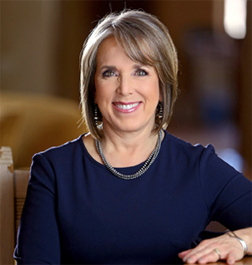
Led by Gov. Michelle Lujan Grisham, the state swiftly shuttered much of its economy, not waiting on the federal government. It also tapped two secret weapons: sophisticated medical knowledge, a legacy from its role as a hub of aerospace research, and the scientific power of the nuclear weapons laboratories that occupy the state’s high desert plateaus.
The state is harnessing the scientific power of two national nuclear laboratories to process still more coronavirus tests. Normally dealing in physics to secretively maintain the nation’s nuclear weapons arsenal, Los Alamos and Sandia national laboratories will not just test, but model and even help search for a vaccine for the virus. (Full Story)
Behind the data: Breaking down the statistical models of COVID-19
Atlanta Police Officer taking precautions, AJC photo.
The Los Alamos National Laboratory, a top-tier government research lab, has developed a statistical model that has, so far, proven accurate at forecasting cases and deaths over various time spans. In Georgia, the lab’s model has been particularly accurate. It shows that Georgia’s death toll, currently near 900, will be about 2,300 deaths on June 3. It finds a better than 50-50 chance that the state has already passed the peak surge in confirmed cases. (Full Story)
Work of Los Alamos scientists suggests COVID-19 can turn really bad again
Los Alamos researchers built a statistical model for how fast the curve is flattened in 51 countries. LANL image.
Los Alamos scientists estimated how fast the curve is flattened in 51 countries. They determined that arbitrarily re-opening societies can allow COVID-19 to undo that progress much faster than it took to achieve it. Widespread testing would help to manage the difference.
"The number of cases averted in two weeks of intervention will be regained in only one week," if all measures are completely relaxed, according to the paper, titled, "Decline In Global Transmission Rates Of COVID-19." (Full Story)
Coronavirus models made governments take action, but how useful are they really?
South Korea implemented mass testing, image from SCMP.
Sara Del Valle, a mathematical epidemiologist at Los Alamos National Laboratory in New Mexico, said that while including “every single variable is challenging or maybe impossible due to lack of needed data, we can build models to consider multiple variables and trade-offs between those variables”.
“We tend to start with simpler models and build up as more information becomes available,” she said. In principle, at least, the mathematics behind modelling are relatively straightforward and similar across simulations. Calculations are based on estimates of how many people are at risk of infection, how many people are infectious and how many people will die or have recovered and are therefore assumed to be immune. (Full Story)
Most U.S. states will need a lot more testing to safely reopen
Covid-19 sample collection in Florida, image from KQED.
Ashish Jha, director of the Harvard Global Health Institute and colleague Ben Jacobson crunched the numbers two ways for each state. Both start with the number of deaths projected for May 15 by Los Alamos National Laboratory, whose COVID-19 model the Centers for Disease Control and Prevention consults. Los Alamos projects that, nationally, the death toll on that day will be 545 — but more if states keep easing up on social distancing. For comparison, on April 25, the U.S. reported just over 2,065 new COVID-19 deaths. (Full Story)
Why we need better science to pinpoint small, underground nuclear tests
1946 Atomic bomb test in the Marshall Islands, From Defense News.
One of the ways we’re improving our estimations is through experimentation. Recently, multiple National Nuclear Security Administration laboratories, including Los Alamos National Laboratory, participated in a series of experiments that analyzed underground chemical explosions to advance nuclear detonation detection capabilities. The experiment used buried explosives in the Nevada desert to generate seismic and acoustic signals similar to those emitted by an underground nuclear detonation — allowing scientists to better understand how certain signals move through the Earth. (Full Story)
Restartable solid rocket fuel could help reduce space junk
An artist's depiction of satellites orbiting Earth. NASA image.
Nicholas Dallmann is a research engineer at Los Alamos National Laboratory, a U.S. Department of Energy facility. He contributed this article to Space.com's Expert Voices: Op-Ed & Insights. The project he describes is funded by Los Alamos Laboratory Directed Research and Development.
At Los Alamos National Laboratory, we're working to change this. We've recently developed and demonstrated the ability to stop and restart solid rocket motors many times — something that has never been done before. (Full Story)
Mining the Moon seems more possible than ever
Mining operations on the moon, Illustration from PopMech.
One choice for the job would be a small nuclear reactor, and NASA has pursued this and made several breakthroughs. In 2018, researchers from Los Alamos National Laboratory, Nevada National Security Site, and NASA put their Kilowatt Reactor Using Stirling Technology (KRUSTY) through a 28-hour continuous full-power demonstration.
NASA likes this fission reactor because it’s coupled to a Stirling engine, it’s closed-cycled, and it’s regenerative. Those are long-lasting, low-maintenance devices, the kind of power source that could efficiently power an extraterrestrial thermal mining operation. (Full Story)
Los Alamos team aims organic imager at Venus
Engineers at Los Alamos National Laboratory (LANL) are hoping to send a new photonics-based instrument to Venus to seek out organic compounds that may indicate the presence of extra-terrestrial life.
Called the “OrganiCam”, the instrument uses a combination of fluorescence lifetime imaging and Raman spectroscopy to identify organic molecules, with a sensitivity in the parts-per-billion range.
LANL’s director of global security programs, Andy Erickson, discussed the development during a plenary talk for this week’s SPIE Defense and Commercial Sensing (DCS) Digital Forum - the virtual event that has replaced the scheduled DCS conference and exhibition in Anaheim, California. (Full Story)
A proposal for the first manned interstellar spaceship
Illustration of the local interstellar neighborhood, from Space Daily.
Solar One is a proposed human-crewed spaceship that would integrate three existing or near-term technologies: the LANL Mega Power Reactor, a larger version of NASA' Sunjammer light sail, and an updated version of the HELLADS laser system.
Firstly, the LANL (Los Alamos National Laboratory) Mega Power Reactor is a fission reactor that weighs 35 tons. It is able to produce up to 10 MW, or the equivalent of 2 MW of continuous power for 12 years.
A micro fission reactor such as the LANL Mega Power Reactor could cost around 16 million dollars, a HELLADS laser system around 21 million dollars, and the Sunjammer mission had a total cost of 27 million dollars. (Full Story)
A fever in the dust
UC Irvine graphic.
“Valley Fever is an example of a disease that will probably be more widespread from climate change,” says Morgan Gorris, a postdoctoral research fellow at Los Alamos National Laboratory and a former graduate student at UC Irvine, who maps out environmentally influenced diseases, like Valley Fever. “I anticipate we will see larger health impacts from this disease in the future.”
Current maps of the disease are incomplete at best. Valley Fever is not required to be reported to the CDC. Texas, a state on the edge of the endemic region, chooses not to report Valley Fever cases nationally.
“Texas has been known to have cases since the 1930s,” says Gorris. “Some counties do report their case counts, but the whole state does not. It's not mandated. I feel like I would have a lot better understanding of where the boundary of this disease is if I had case data for Texas.” (Full Story)
Are salt deposits a solution for nuclear waste disposal?
Phil Stauffer testing the inflatable packer, LANL image.
Around the world, there are pools of water filled with nuclear waste waiting for their final resting place. This is waste that was created from decades of nuclear power generation, and the waste must be handled carefully.
In the United States, scientists are studying several solutions for disposing of these wastes. Phil Stauffer and researchers at Los Alamos National Labs have been working with the US Department of Energy and other national laboratories on one long-term, safe, disposal solution: salt.
"Deep salt formations that already exist in the United States are one candidate for long-term disposal," says Stauffer. "This 'high-level' nuclear waste can create a lot of heat, in addition to the radioactivity that must be contained. We need to develop a clear path to dispose of this waste." (Full Story)
To subscribe to Los Alamos Press Highlights, please e-mail listmanager@lanl.gov and include the words subscribe PressHighlights in the body of your email message; to unsubscribe, include unsubscribe PressHighlights.
Please visit us at www.lanl.gov