Friday, November 22, 2019


What is dark matter made of? These are the top candidates

The MiniBooNE detector is filled with mineral
oil and tiny sensors, FermiLab photo.

While it’s too soon to chalk up the observed flavor anomalies to sterile neutrinos, they do slot in nicely. “There’s clearly something going on, and it’s tantalizing,” says Richard Van de Water, a physicist at Los Alamos National Laboratory and MiniBooNE co-spokesman.

Assuming sterile neutrinos prove legit, they are still likely neither sufficient in mass nor number to constitute the bulk of dark matter. But just as normal neutrinos come in three flavors, multiple kinds of sterile neutrinos, with different masses, may also exist. And going a step further, neutrinos may not be the only kind of particle with a sterile counterpart. (Full story)


It's still not aliens: 'Mars Bug' claim could damage the search for life

The Martian landscape, NASA image.

An Ohio scientist claims to have found photographic proof of "insect and reptile-like" life on Mars. But, as always, it's not aliens, other researchers say.

"I think it's really easy to find patterns in images, especially when they're out of context," Nina Lanza, a planetary scientist at Los Alamos National Laboratory, told Space.com. "They're little clips of larger images and there's no scale bar on them ... you could imagine a lot of different shapes in there. That's not a good way to do this kind of assessment." (Full story)


Understanding the mechanism of a viral explosion

Sometimes, after anti-viral medicines are administered, a 'rebound' occurs and the virus again replicates (and at a rapid pace). The mechanisms behind this have been the subject of new research.

One of the dreaded features of a Human Immunodeficiency Virus (HIV) infection can be the possible rebound of the virus after undergoing an otherwise successful antiretroviral (ART) regimen. Understanding the viral replication and dramatic growth that sometimes appears subsequent to ART treatment is the subject of a new study by scientists from Los Alamos National Laboratory and the National Institutes of Health’s National Institute of Allergy and Infectious Diseases.

The virologists have defined the principles governing whether HIV-1 spread among cells fails or becomes established by coupling stochastic modelling with laboratory experiments. HIV-1 is the most common and pathogenic strain of the virus (one of the challenges for the treatment of the human immunodeficiency virus is its high genetic variability). (Full story)


Los Alamos National Laboratory commits to advancing gender equality In nuclear policy

Los Alamos Director Thom Mason,
LANL photo.

Los Alamos National Laboratory is the first national lab to join Gender Champions in Nuclear Policy, a leadership network that brings together heads of organizations working in nuclear policy who are committed to breaking down gender barriers and making gender equality a reality in their spheres of influence.

“Nuclear policy, like many technological fields, has long been a male-dominated space,” LANL Director Thom Mason said. “As a result, women in the field have too often been marginalized. In joining Gender Champions in Nuclear Policy, the Laboratory is committing to actively working to bring more women into the field, amplify their voices, and foster a culture of respect. We’re proud to be a part of this network and look forward to seeing the positive changes that result.” (Full story)

Also from the Daily Post this week:

Beierschmitt Briefs RCLC On Lab Infrastructure Plans

Beierschmitt shares infrastructure plans with
the RCLC Board, Daily Post photo.

It’s no secret Los Alamos National Laboratory has growing pains. Increased budgets and increased staff are a plus, but the extra projects and people have stretched the infrastructure resources at LANL … and the future goals of the Lab will stretch them even more.

LANL Deputy Director of Operations Kelly Beierschmitt addressed these issues during a presentation to the Regional Coalition of LANL Communities Board Friday in City Council Chambers in EspaƱola. Beierschmitt is responsible for the Lab's operations and facilities services, maintenance and infrastructure planning. (Full story)


‘The Ribosome’ exhibit opens at the Bradbury Science Museum

Augmented Reality brings the ribosome to
life. LANL photo.

This visual and interactive exhibit provides an insight into how life works as 3D and Augmented Reality brings the ribosome to life. It also explores the potential for developing new antibiotics and fighting diseases like cancer and genetic diseases.

The friendly exhibit also features a cartoon ribosome that helps visitors including STEM students to understand the science behind the ribosome. Curated by scientist Karissa Sanbonmatsu of the Lab’s Theoretical Biology and Biophysics group, the exhibit leverages the Los Alamos National Laboratory’s supercomputing technology. (Full story)


Harvesting of red light accelerates plant growth

Quantum dot-enabled retrofit greenhouse
film, UbiQD photo.

A Los Alamos startup’s quantum dots that emit red light could rake in plenty of green for greenhouse growers.

That’s according to the global market research firm Frost & Sullivan, which this month bestowed its 2019 New Product Innovation Award on UbiGro, a new window film for greenhouses created by New Mexico-based Ubiquitous Quantum Dots, or UbiQD Inc.

That’s a huge endorsement for a small New Mexico startup that launched in 2014 with technology licensed from Los Alamos National Laboratory and the Massachusetts Institute of Technology. (Full story)

Monday, November 18, 2019


Artificial intelligence can help stop nuclear proliferation

Guest column author Thom Mason,
Laboratory Director, LANL photo.    

The international nuclear arms control regime is approaching a critical juncture. If new nuclear weapons treaties are to be negotiated, ratified and enforced, they will need to be underpinned by strong technical monitoring capabilities. The Department of Energy’s National Nuclear Security Administration is leveraging its expertise and technology to meet this challenge, understanding that in nuclear nonproliferation, you can’t verify what you can’t see.

The United States is placing renewed urgency on developing the science and technology required to monitor our adversaries’ nuclear activity — specifically by harnessing the power of artificial intelligence and the unmatched, high-performance computing capabilities found at DOE’s national laboratories. DOE houses four of the world’s top 10 fastest supercomputers, including the top two, and we are already at work on developing three next-generation, exascale machines, able to conduct a billion billion calculations per second. Coupled with our advances in AI, those technologies will strengthen our nonproliferation efforts while helping to ensure that our own nuclear weapons stockpile remains safe, reliable and effective.

At Los Alamos National Laboratory, we are using AI to sift through data from an international network of sensors that look for underground seismic events that could indicate an illicit nuclear explosive test. With more than half a million seismic events worldwide each year, automated calculations are required to distinguish potential nuclear explosions from naturally occurring earthquakes. (Full story)


Precise proton beam takes aim at cancer

One of the biggest challenges in battling cancerous tumors is destroying all the cancer cells while protecting the healthy tissue surrounding the tumor. Removing a tumor surgically or treating it with radiation is a risky business, particularly when the tumor grows close to vital organs.

Proton therapy is a precise and highly accurate nonsurgical cancer treatment method. But the technique is only as good as the ability to accurately kill cancer tissue and spare the healthy tissue around it.

Scientists at Los Alamos National Laboratory are advancing a technology known as proton radiography to increase the precision and accuracy of proton therapy. (Full story)


Boom times on the Hill need to be shared

Change is coming to Los Alamos National Laboratory — and it’s important that Northern New Mexico residents pay attention to what is happening on the Hill.

There is the nuclear laboratory’s evolving mission, with the lab expanding plutonium pit production for nuclear weapons. By 2026, LANL is being asked to build 30 pits a year; another 50 pits are supposed to be built at the Department of Energy’s Savannah River Site in South Carolina.

Along with construction work — at a price tag in the billions, once the money is awarded and spent — LANL Director Thom Mason says the lab is hiring additional workers, about 1,000 a year for the foreseeable future. Of those, about half are new, with the remainder replacing retiring scientists and other lab workers. Mason called it the biggest increase in hiring in at least 30 years, and lab officials expect the jobs boom to continue at least through 2023.

And what does that mean to Northern New Mexico? Consider that this year, around $400 million in money spent for subcontractors has gone to New Mexico companies, also hiring because of the work. Over half the new lab hires, too, are from New Mexico, Mason said. (Full story)


Fluid dynamics provides insight into wildfire behavior

Stream traces of winds reaching the  left flank and head
of a simulated fire spreading up a steep slope.

The Kincade Fire has been burning through Sonoma County, California, displacing people from their homes and leaving destruction in its wake. It is a stark reminder of the increasingly pressing need for a better understanding of how fires begin and spread.

This is where Rodman Linn and his research come in. He develops and uses computational models of the coupled interaction between the wildfires and surrounding atmosphere at Los Alamos National Laboratory. In the November 2019 issue of Physics Today, Linn describes a few of the many ways that fluid dynamics controls the behavior of fires.

It's incorrect to view wildfires as advancing walls of flame, as they often are conceptualized. The movement and behavior of fires are far more complex.

"The buoyancy caused by the energy release of the fire itself interacts with the ambient winds to produce complex patterns of air movement that dictate the fire's behavior," said Linn, a senior scientist at Los Alamos National Laboratory. (Full story)


A Black Hole Threw a Star Out of the Milky Way Galaxy

An artist’s impression of the black hole at the center
of the Milky Way hurling a star called S5-HVS1 from
the galaxy’s Credit: James Josephides/Swinburne
Astronomy Productions, from NYT.

There are fastballs, and then there are cosmic fastballs. Now it seems that the strongest arm in our galaxy might belong to a supermassive black hole that lives smack in the middle of the Milky Way.

Astronomers recently discovered a star whizzing out of the center of our galaxy at the seriously blinding speed of four million miles an hour. The star, which goes by the typically inscrutable name S5-HVS1, is currently about 29,000 light-years from Earth, streaking through the Grus, or Crane, constellation in the southern sky. It is headed for the darkest, loneliest depths of intergalactic space.

The astronomers hypothesize that the runaway star was once part of a double-star system that came too close to the black hole. One of the pair fell in, and the other was sling-shotted away at hyper speed. The process, a three-body gravitational dance, was first predicted by Jack Hills, a theorist at Los Alamos National Laboratory, in 1988. (Full story)

Friday, November 8, 2019


A new strain of HIV is recorded under group that caused pandemic

A virus sample from Abbott Laboratories. WSJ photo.

Scientists using advanced DNA sequencing technology have documented a previously unidentified strain of HIV under the group that is responsible for the vast majority of human infections.

Researchers and epidemiologists don’t expect the new Group M strain to change the way HIV is diagnosed or treated. Still, they say new strains can offer clues on how HIV evolved and spread.

“There’s a lot of mystery around why certain things happened. New strains can unravel some of that unknown history,” said Brian Foley, an HIV geneticist at New Mexico’s Los Alamos National Laboratory, which holds the largest HIV gene bank and sets the guidelines on classifying new strains. Dr. Foley wasn’t involved in Abbott’s research. (Full story)


Why U.S. must win race to build first practical quantum computers

Guest column author Thom Mason,
Laboratory Director, LANL photo.    

Today, Los Alamos and other Department of Energy national laboratories, working closely with industry, continuously push the farthest frontiers of computing and related technologies in support of scientific discovery. Many of those breakthroughs trickle down to everyday life.

That technological landscape may splinter as Moore’s law ends, threatening to undermine the broad-based economic growth and scientific advancement that has enabled U.S. global leadership for decades. Disruptions will reverberate from the economy to science to national security. (Full story)


Navigating a career in secret physics


Astrophysicist Chris Fryer and his family were driving back from a monthlong workshop on neutron-star mergers when he got word of a new gravitational-wave discovery. The fifth of the Laser Interferometer Gravitational-Wave Observatory’s catches, the August 2017 event appeared to be the first detected from two colliding neutron stars. “I recall vividly having my wife read me the email while I was driving and me telling her I didn’t believe her,” he says. His wife, Aimee Hungerford, is also an astrophysicist. A few days later, data started to become available. (Full story)


Between a varnished rock and a hard place

Nina Lanza (left) studying rock varnish
in California, photo from Nina Lanza.

In this episode, Los Alamos National Laboratory researchers Nina Lanza and Chris Yeager discuss their investigations into rock varnish in New Mexico, which could help them understand whether life is present on Mars. Rock varnish is a mysterious coating found on rocks in some of the harshest and most Mars-like landscapes on Earth, but no one knows whether rock varnish is created by living things. If so, finding it on Mars would be a sign that Martian life exists now or has existed in the past. (Full story)


Voyager 2 reveals new details about interstellar space

Voyager test model at the Kennedy
Space Center in 1976, NASA photo.

Dan Reisenfeld, a research scientist at Los Alamos National Laboratory, who was not involved in the research, says astronomers took bets on when they were going to make it through [the heliosphere]. “Voyager’s fame came from its exploration of the planets,” Reisenfeld tells Inverse. “Then it went quiet for years because it’s just traveling through the depths of space beyond the planets.”

The second set of data also gave a better idea of the shape of the heliosphere.

“When Voyager 2 crossed the heliopause, it showed us that our heliosphere is not perfectly round but that it’s asymmetric,” Reisenfeld says. (Full story)


Nine Los Alamos National Laboratory projects win R&D 100 Awards

Histato Yamaguchi holding a photosensitive
cell that has been coated with Atomic Armor,
a R&D 100 winning project. LANL photo.

“It’s an honor to have Los Alamos National Laboratory’s innovation recognized by the broader community with these nine R&D 100 awards,” said Laboratory Director Thom Mason. “Behind all of these awards are people willing to take risks and think unconventionally about big problems in areas like national security, big data, and energy transmission. Their originality has brought the Laboratory to where we are today. Congratulations to the winners, special recognition awardees, and finalists for their outstanding achievements.” (Full story)


Tech startup FidelityEHR receives innovation grant


FidelityEHR developed an electronic health records system for behavioral health, funded in part by the National Institute of Mental Health, to provide care coordination for at-risk populations with complex needs.

FidelityEHR also is collaborating with the New Mexico Small Business Association and Los Alamos National Laboratory to develop artificial intelligence/machine learning technology to quickly identify factors for clients at risk for suicide or opioid overdose. (Full story)

Friday, November 1, 2019


Using quantum computers to test the fundamentals of physics

White crosses represent non-interfering quantum states that behave classically for a simple quantum problem, LANL image.

A quantum-computing algorithm, developed by scientists at Los Alamos National Laboratory and the University of California, Davis — including Andrew Sornborger and Andreas Albrecht  — opens a new window on the connection between the quantum and classical worlds and the transition that must occur as we zoom out from the smallest scales.

To study the quantum-to-classical transition, physicists need to evaluate how close a quantum system is to acting classically. Among other effects, physicists must consider the fact that quantum objects are subject to wave-particle duality. (Full Story)


LANL protects milkweed to preserve monarchs

Makenzie Quintana, a student at Los Alamos National Laboratory, provides a perch for a monarch butterfly, LANL photo.

As part of Los Alamos National Laboratory’s environmental stewardship efforts, a Los Alamos team has been documenting the cycles and seasons of monarch butterflies, and the location of milkweed on laboratory property. These efforts will better inform management decisions if this species is listed under the Endangered Species Act. They were able to document eggs on milkweed in late June and caterpillars enjoying milkweed into September. (Full Story)


Weatherwatch: cloud 'x-rays' seek to reveal anatomy of a storm


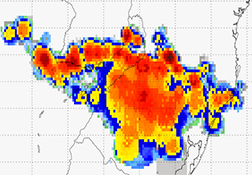
GLM imagery of a convective storm over southern Brazil. LANL image.

Scientists have long used satellite cameras, such as the Geostationary Lightning Mapper (GLM), to count lightning flashes and monitor storms. Now Michael Peterson, of Los Alamos National Laboratory, is using the pulses of illumination to produce “fulminograms” showing clouds from inside.

“The output resembles an x-ray image of the storm,” Peterson says. “When light must penetrate thick convective cells, they stand out as dark spots in the image, while the brightest spots show us where lots of light can leak out of the cloud.” (Full Story)


VW to test quantum navigation app in real traffic

A quantum computer, D-Wave photo.

Volkswagen AG plans to test a quantum-computer-powered navigation app in Lisbon next week, part of a larger plan to include such a feature in its vehicles within the next few years.

“What’s exciting about this work is that it’s being applied in the real world,” said Scott Pakin, a computer scientist at Los Alamos National Laboratory.

Other auto makers including Ford Motor Co. are experimenting with how quantum computing could quickly optimize driving routes and improve the structure of batteries for electric vehicles. (Full Story)


Los Alamos National Lab wins CDC’s FluSight Challenge

“Accurately forecasting diseases is similar to weather forecasting in that you need to feed computer models large amounts of data so they can ‘learn’ trends,” Dave Osthus, a statistician at Los Alamos and developer of the computer model, Dante, said. “But it’s very different because disease spread depends on daily choices humans make in their behavior—such as travel, hand-washing, riding public transportation, interacting with the healthcare system, among other things. Those are very difficult to predict.” (Full Story)


LANL receives $5 billion to upgrade aging facilities

Some facilities at Los Alamos National Laboratory — the nation’s foremost nuclear weapons research center — date to the 1950s, said Thom Mason, LANL director.

That reality, coupled with the lab’s evolving mission, is spurring a $5 billion upgrade to aging buildings and equipment still in use in the 21st century, Mason said in an interview this week. Though state of the art when built during the Cold War, some aging infrastructure is now outdated. (Full Story)


Five LANL scientists elected 2019 APS Fellows

Top row from left, Herrmann, Hsu and Hurd. Bottom row from left, Prestridge and Van de Water, LANL photo.

Five LANL scientists have been elected 2019 Fellows of the American Physical Society (APS). Hans Herrmann, Scott Hsu, Alan Hurd, Katherine Prestridge and Richard Van de Water and were chosen for their “exceptional contributions to the physics enterprise”.


Fewer than one half of one percent of APS members are elected as Fellows each year.
These five scientists represent the breadth of physics contributions made at the Laboratory. Van de Water said of the award, “The thrill of doing science is an award itself, an APS Fellowship honor makes it that much better.” (Full Story)

To subscribe to Los Alamos Press Highlights, please e-mail listmanager@lanl.gov and include the words subscribe PressHighlights in the body of your email message; to unsubscribe, include unsubscribe PressHighlights.

Please visit us at www.lanl.gov