Friday, August 24, 2012


After 352-Million-Mile Trip, Cheers for 23 Feet on Mars

On Sunday, the rover fired a laser instrument for the first time, hitting a rock with 30 bursts in 10 seconds and analyzing the atomic makeup from the resulting flashes of light.

Having succeeded at rock-zapping on Sunday, scientists turned the laser, which wasdeveloped at Los Alamos National Laboratory, to vaporize small bits at six more locations. So far, most of the rocks appear to be a type, common on Mars, that forms from the rapid cooling of lava (full story).


Mars Curiosity rover fires laser for first time

“Our team is both thrilled and working hard, looking at the results. After eight years building the instrument, it’s payoff time!” said ChemCam principal investigator Roger Wiens of Los Alamos National Laboratory in New Mexico.

The initial use of the laser was primarily for target practice, but it appears to be yielding more data than expected. According to ChemCam Deputy Project Scientist Sylvestre Maurice of the Institut de Recherche en Astrophysique et Planetologie (IRAP) in Toulouse, France, the data from the initial test is better than data collected on Earth in terms of signal-to-noise ratio (full story).


Mars rover Curiosity zaps first rock

ChemCam was designed and built at Los Alamos and is a joint project between the U.S. Department of Energy and the French national space agency. It is one of 10 state-of-the-art instruments making up Curiosity’s science payload (full story).


Stories also appeared on CNN
 

The BBC


Chemcam Laser First Analyzes Yield Beautiful Results

Members of the Mars Science Laboratory Curiosity rover ChemCam team, including Los Alamos National Laboratory scientists, squeezed in a little extra target practice after zapping the first fist-sized rock that was placed in the laser's crosshairs last weekend.

"The spectrum we have received back from Curiosity is as good as anything we looked at on Earth," said Los Alamos National Laboratory planetary scientist Roger Wiens, Principal Investigator of the ChemCam Team. "The entire MSL team was very excited about this and we popped a little champagne." (Full story)
 

The Curiosity rover’s nuclear-powered laser

ChemCam can analyze the resulting sparks in a process called "laser-induced-breakdown spectroscopy," or LIBS for short, says Astronomy News. LIBS reads the spectrum of light emitted by the vaporized rock using three different spectrometers. That data is then beamed back to NASA and forwarded to the Los Alamos National Laboratory in New Mexico for study (full story).


Curiosity Zaps Its First Martian Rock

ChemCam employs a technique called "laser-induced breakdown spectroscopy", which determines the composition of ionized gas from a target in extreme environments such as inside nuclear reactors.

The laser, telescope, and camera were provided by CNES (the French space agency), while the spectrometers, electronics, and software were built at Los AlamosNational Laboratory (full story).


In Southwest, Worst-Case Fire Scenario Plays Out

As the Earth's average temperature creeps upward, climate scientists have predicted record heat waves and droughts. That's what we've seen this summer in the U.S.

"What we have now is a gradual trend towards warmer temperatures," says Park Williams, an ecologist at the Los Alamos National Laboratory in New Mexico. He says climate change is exaggerating the normal swings in weather (full story).


Twin Satellites Will Help Improve Space Weather Forecasts

On Aug. 24, NASA will launch two identical satellites from Cape Canaveral, Fla., to begin its Radiation Belt Storm Probes (RBSP) mission. The theory and modeling teams at UCLA and Los Alamos National Laboratory bring the total collaboration to five institutions (full story).


Sonic cooker uses sound waves to reduce energy poverty

The project is being led by the UK's University of Nottingham, but has drawn on the expertise of partners around the world including the Los Alamos National Laboratory (LANL) in New Mexico.

LANL researchers Scott Backhaus and Greg Swift demonstrated the first-ever thermo-acoustic engine in 1999, adapting the principles originally outlined by Scottish engineer Robert Stirling in the 19th century (full story).


Laser research shows promise for cancer treatment

Scientists at Los Alamos National Laboratory have observed, for the first time, how a laser penetrates dense, electron-rich plasma to generate ions. The process has applications for developing next generation particle accelerators and new cancer treatments.

Plasmas dense with electrons normally reflect laser light like a mirror. But a strong laser can drive those electrons to near the speed of light, making the plasma transparent and accelerating the plasma ions (full story).

Also from R&D Magazine this week:

Testing sealed containers, no valves needed

Los Alamos National Laboratory, Los Alamos, N.M., and Y-12 National Security Complex, Oak Ridge, Tenn., have introduced a way to test valveless sealed containers without compromising the integrity of the vessel. Called Valveless Laser Processing, the innovation uses a single laser to remotely penetrate, sample, and reseal hermetically sealed containers (full story).


Bishop to lead LANL STE Directorate

Alan Bishop has been selected to be the laboratory’s next principal associate director for Science, Technology and Engineering (PADSTE). Bishop has been acting in that role since Aug. 29, 2011.

Over the course of a distinguished 30-year career as a research scientist and leader, Bishop has more than 700 publications in archival journals and has served as a guest scientist, guest scholar and visiting professor (full story).


To subscribe to Los Alamos Report, please send an email and include the words "subscribe losalamosreport" in the body of your email message; to unscubscribe, include "unsubscribe losalamosreport".

Please visit us at www.lanl.gov

And don't forget to follow us on Twitter, Facebook, YouTube and Flickr!

Friday, August 17, 2012


High-tech tool predicts fire behavior in bark beetle-ravaged forests

During the Las Conchas fire of 2011, a Los Alamos resident watches the Jemez Mountains burn.  LANL photo.

Fire fighters facing fast-moving wildfires need better tools to predict erratic fire behavior, especially in forests with dead trees caused by massive outbreaks of bark beetles whose predations create an abundance of dead fuel and changes in the tree canopy structure.

Tools typically available to incident commanders and fire crews are not designed for these potentially highly variable conditions and may not provide accurate fire behavior predictions, scientists have determined. (Full Story)


Lab helps forecast spread of wildfires

KRQE anchor Kim Vallez introduces the story.  From KRQE.         

Scientists at Los Alamos National Laboratory have helped create a tool to better predict the movement of wildfires ... LANL scientists along with the U.S. Forest Service have created a high-tech computer model that predicts behavior by looking at all those things plus the affects of bark beetle infestation, drought, heat transfer and the air flow in the fire itself. (Full Story)


NASA is tracking electron beams from the sun

NASA's Advanced Composition Explorer (ACE) observes a wide array of particles that flow toward Earth from the sun.  NASA illustration.

"People think of the sun as giving out light and heat," says Ruth Skoug, a space scientist at Los Alamos National Laboratory in Los Alamos, N.M. "But it is also always losing particles, losing mass."

Skoug says that each fast-moving electron is by and large constrained to move along magnetic field lines that flow out from the sun, some of which loop back totouch the sun again, others which extend out to the edges of the solar system. (Full Story)

This story also appeared in Science Daily and several other science oriented science blogs.


Obama congratulates Mars Curiosity scientists

The President speaks to the JPL team from Air Force One. NASA image.

Obama spoke by phone from Air Force One as he flew to a campaign stop in Iowa eight days after the car-sized rover landed on the Martian surface. The touchdown followed a complex series of maneuvers involving intricately timed rocket firings

Some of the scientists involved in the project come from the Los Alamos NationalLaboratory. A team of LANL scientists, led by principal investigator Roger Wiens, developed the ChemCam. (Full Story)


Also from the Monitor this week:

Kintzer gains spot on governing board

Norman J. Pattiz, chairman of Lawrence Livermore National Security, LLC (LLNS) and Los AlamosNational Security, LLC (LANS), has named Donald J. Kintzer as an Independent Governor on the LLNS and LANS Boards of Governors.

The LLCs manage Lawrence Livermore National Laboratory in Livermore, Calif. and Los Alamos National Laboratory, respectively, for the U.S. Department of Energy. (Full Story)


LANL’s economic impact: thousands of staffers, millions of dollars

Technical Area 3.  LANL photo.

Los Alamos National Laboratory is huge, and so is its economic impact on the seven-county region referred to as northern New Mexico. Sprawling over 36 square miles in Los Alamos County, the lab employs 10,751 people, 6,979 of whom are regular full-time employees.

According to a March 2011 study by the University of New Mexico’s Bureau of Business and Economic Research, LANL’s economic impact in New Mexico totaled 23,641 jobs, $1.6 billion in labor income and $2.9 billion in total economic output. (Full Story)


Farmington Fire Department is a “hazard’ to compete with

Farmington fire fighters with their HAZMAT Challenge trophy. Farmington Daily News photo.

The Farmington Fire Department Hazardous Materials team took second place at the 16th annual HAZMAT Challenge at the Los Alamos National Laboratory.

The challenge was held from Aug. 7-10 at the laboratory's Technical Area 49 located near Bandelier National Monument. The program provides hazardous materials responders the opportunity to network and learn new response techniques under realistic simulations. (Full Story)


Hazmat teams compete in LANL challenge

LANL’s hazmat team discusses how its going to enter a “contaminated” vehicle.  Monitor photo.

Fire departments and emergency response teams from across the region met in Los Alamos this week to prove who has the best team when it comes to handling emergencies. And not just any emergencies either; encountering mobile meth labs, overturned rail cars full of dangerous chemicals, even clearing passenger buses of suspicious chemicals were just some of the challenges the teams encountered at Los Alamos National Laboratory’s 16th annual Hazmat Challenge. (Full Story)


Edmond hazmat team trains at Los Alamos

HAZMAT team members evacuate a simulated victim. LANL photo.

The training scenarios were part of the Aug. 7-10 Hazmat Challenge, an annual event on the grounds of the Los Alamos National Laboratory. The lab is 35 miles northwest of Santa Fe, N.M., on 36 square miles of U.S. Department of Energy-owned property.

“It’s essential for us as training goes,” said Edmond hazmat team coach Lance Morrison. “It’s not about the winning. It’s about the training.” (Full Story)


APS and LANL jointly announce appointment of Eli Ben-Naim as Senior Editor

The American Physical Society and Los Alamos National Laboratory are very pleased to jointly announce that Eli Ben-Naim has been appointed Senior Editor of Physical Review E, the preeminent international journal in statistical, nonlinear, and soft matter physics. (Full Story)

 
To subscribe to Los Alamos Report, please e-mail listmanager@lanl.gov and include the words subscribe losalamosreport in the body of your email message; to unscubscribe, include unsubscribe losalamosreport.

Please visit us at www.lanl.gov
And follow us on Facebook, Twitter, YouTube, and Flickr!

Friday, August 10, 2012


Curiosity gears up to zap rocks in huge crater at red planet

The six-wheeled mobile laboratory will rely heavily on a ChemCam laser characterization instrument and several other devices it is set to carry on its projected 19-kilometer journey. ChemCam —developed at Los Alamos National Laboratory (LANL) and the French space institute (IRAP) — is designed to rapidly analyze rock and soil compositions outside the rover, identifying samples that could be studied further by additional instruments inside the rover. The LANL-built CheMin, for example, will use X-ray diffraction to determine the composition of mineral samples collected and dropped into the rover via a funnel. (Full Story)


LANL science team celebrates Mars landing


LANL Video
Members of the LANL and French Space Institute ChemCam science team celebrated the successful landing of the Curiosity Rover on the surface of Mars and then quickly began working toward the first-ever laser-based interrogation of Mars' geologic composition. Watch LANL's video above.


Rover touches down on Mars


The latest Mars rover, Curiosity, landed safely and successfully on the red planet early Monday morning to delight of hundreds at Los Alamos National Laboratory. About 400 people from Los Alamos gathered at the Bradbury Science Museum to watch NASA television for the historic moment. (Full Story)


Los Alamos scientists celebrate Curiosity touchdown

LANL Video.

Los Alamos National Laboratory scientists were among those gathered in Pasadena, Calif., to cheer as the Curiosity rover landed successfully on Mars on Sunday night. “I can’t describe the feeling when we realized that Curiosity had landed safely on the planet,” said LANL planetary scientist Roger Wiens, principal investigator of the Mars Science Laboratory mission’s ChemCam team, in a news statement. (Full Story)


Curiosity lands safely on Mars

One of the first photos taken by a camera at the front of the rover. Mount Sharp, the mission's ultimate destination, looms ahead. JPL image.

In a show of technological wizardry, the robotic explorer Curiosity blazed through the pink skies of Mars, steering itself to a gentle landing inside a giant crater for the most ambitious dig yet into the red planet’s past. A chorus of cheers and applause echoed through the NASA Jet Propulsion Laboratory on Sunday night after the most high-tech interplanetary rover ever built sent a signal to Earth. (Full Story)

Also from the Monitor this week:

Scientists, residents cheer Mars landing

Part of the Curiosity rover exhibit at the Bradbury Science Museum.  LA Monitor Photo.

NASA’s Curiosity rover on Monday transmitted a low-resolution video showing the last 2 1/2 minutes of its white-knuckle dive through the Mars atmosphere, giving Earthlings a sneak peek of a spacecraft landing on another world. As thumbnails of the video flashed on a big screen on Monday, scientists and engineers at the NASA Jet Propulsion let out “oohs” and “aahs.” (Full Story)


Atom bomb historic sites may become national park

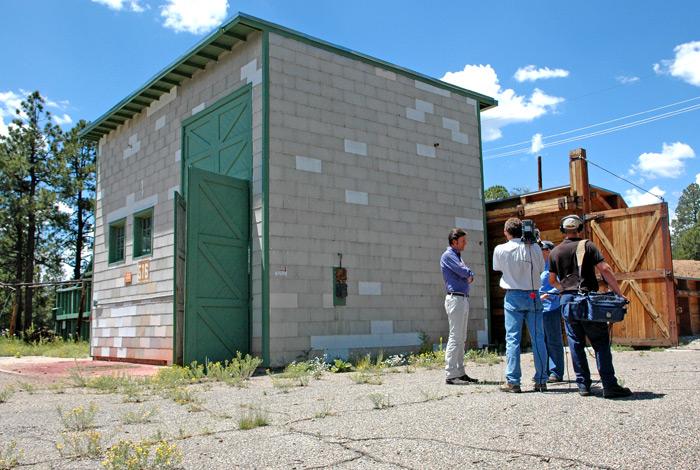
CBS crew visits V-Site. LANL Photo.

High in the New Mexico desert stands a small unremarkable building. But, if you had peered through its now cobwebbed keyhole back in 1945, what you would have seen is the device that changed the world.

"The Gadget," as it was euphemistically called, was the first atomic bomb ever tested. Scientists and engineers at the Los Alamos National Lab rolled it out of the remaining barn doors some 67 years ago. (Full Story)


Los Alamos researchers study plants’ response to climate change

Plexiglass chambers controlled for temperature and moisture are used to study impacts of predicted climate change on piñons and junipers. LANL Photo

For a plant physiologist whose research points to a looming disaster in the world as we know it, Nate G. McDowell is a surprisingly upbeat guy. “I’m excited. This is such an awesome project,” said McDowell, a Los Alamos National Laboratory staff scientist, as he gave a tour of his latest research site near Bandelier National Monument. (Full Story)    


LANL honors lab’s tech transfer standouts
Los Alamos National Laboratory recognized some of its stars on Thursday evening for innovations ranging from bomb-defusing tools to glow-in-the-dark proteins.


LANL honored several scientists and entrepreneurs with five awards at the LANL Tech Transfer outSTANDING innOVATION Awards for research, patents and devices. Since 1998, the laboratory has held an annual patent and licensing awards reception to honor employees who have been issued patents in the past year and received royalty income for patented and copyrighted work they did at LANL. (Full Story)    


Lab sets shipment record
LANL Image

For the fourth consecutive year, Los Alamos National Laboratory’s TRU Waste Program has sent a record number of transuranic waste shipments to the Waste Isolation Pilot Plant (WIPP) near Carlsbad for permanent disposal. The laboratory’s 172nd shipment of TRU waste this year left Los Alamos bound for WIPP Aug. 2. With two months left in the fiscal year, the laboratory has already beat last year’s fiscal year record of 171 shipments. (Full Story)


To subscribe to Los Alamos Report, please e-mail listmanager@lanl.gov and include the words subscribe losalamosreport in the body of your email message; to unscubscribe, include unsubscribe losalamosreport.

Please visit us at www.lanl.gov

And don't forget to follow us on Twitter, YouTube and Flickr!

Friday, August 3, 2012


A drop-In looking for signs of company

NASA / JPL image.
Packed with ingenious new instruments, the Curiosity rover promises to provide the best-ever examination of the Red Planet, digging up clues to a profound question: Could there ever have been life there?
“[ChemCam] is really designed to be a sentry or advance guard for the rover and identify the most interesting samples,” said Roger C. Wiens, a physicist at Los Alamos National Laboratory who is the instrument’s principal investigator. (Full Story)      


Why Mars rover will be blasting its heat ray as it searches for life

AP image.
The Mars rover Curiosity, which is due on the Red Planet next week, is outfitted with an infrared laser and telescope package called ChemCam that will vaporize bits of rock to study its chemical makeup.
… The technology was adapted for space missions by a team led by Los Alamos National Laboratory geochemist Roger Wiens, ChemCam's lead scientist. The Mars Science Laboratory's mission marks the instrument's maiden flight. (Full Story)    


Martian fever comes to Bradbury
NASA Image.
Curious about Curiosity, the SUV-sized rover scheduled to touch down on Mars on Sunday? Then come to an opening party for a new exhibit about it this Sunday at the Bradbury Science Museum in Los Alamos.

The public is invited to a special opening reception beginning at 10 p.m. Sunday to celebrate Los Alamos National Laboratory technologies aboard the six-wheeled mobile science laboratory. (Full Story)    


 Greenland loses ice in fits and starts

Image: Niels J. Korsgaard, Natural History Museum of Denmark
The surge of ice loss from Greenland between 2005 and 2010, which drove up sea levels around the world, was not unprecedented. A similar spurt happened in the late 1980s, and possibly decades earlier as well.

… The real problem is predicting when warm waters will swash around Greenland's coast, and exactly how that affects the ice, says Stephen Price of the Los Alamos National Laboratory in New Mexico. (Full Story)


LANL to help advance robotics
 
Throwbots are used by the military and law enforcement. Reconrobotics photo.
  A new partnership between Los Alamos National Laboratory and a Minnesota company could accelerate advances in robotic technology for use by the military, law enforcement, businesses and the general public.

LANL and ReconRobotics Inc., a company that specializes in tactical micro-robot systems, recently entered into a research and development agreement to identify, evaluate and produce technologies that could prove to be mutually beneficial. (Full Story)


Also from the Journal this week:

Editorial: Top researchers bring accolades to the state

Amy J. Clarke. LANL photo.                

This week six researchers with New Mexico ties will be among 96 U.S. researchers to receive the 2011 Presidential Early Career Awards for Scientists and Engineers, including Amy J. Clarke, a materials scientist for Los Alamos National Laboratory. (Full Story)


Best defense is a good offense

Manny L’Esperance demonstrates the SimTable. Monitor photo.

On West Jemez Road, in a small room at the Los Alamos National Laboratory’s Emergency Operations Center, sits one the greatest defensive weapons the lab uses against fighting wildfires.

At first glance, it just looks like a sand box propped up on four wooden legs. However, turn off the lights and turn on an overhead projector, and that’s where the similarity to the childhood memories ends. (Full Story)

Also from the Monitor this week:

Seen @ the Scene: Lab Picnic los alamos monitor

Photo Gallery: Hundreds turned out for the annual laboratory picnic with fun-for-the-family games, prizes, demonstrations and food. Free sno cones made life grand for children of all ages, while many participated in dancing and Zumba. (Full Story)


To subscribe to Los Alamos Report, please e-mail listmanager@lanl.gov and include the words subscribe losalamosreport in the body of your email message; to unscubscribe, include unsubscribe losalamosreport.

Please visit us at www.lanl.gov