Friday, September 6, 2019


A mini chemical lab could one day test for toxic nerve agents in the field
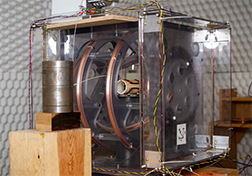
A portable device that detects the chemical fingerprints of different compounds, LANL photo.

A mini version of lab equipment that identifies chemicals in suspect substances could someday help perform on-the-ground testing for chemical warfare agents.

Collecting samples of sarin, VX or other nerve agents and shipping them to a lab for testing can take weeks, says Robert Williams, a physical organic chemist at Los Alamos National Laboratory in New Mexico. “If you can turn this into a portable system, you can make it a lot easier for people to use,” he says. “And you could get the results immediately.” (Full Story)


Quantum Darwinism spotted in diamond spins

Spins in diamond have been used to chart the transition between the quantum and classical worlds. Courtesy: iStock.

Quantum Darwinism, put forward by Wojciech Zurek of Los Alamos National Laboratory in New Mexico, argues that the classical states we perceive are robust quantum states that can survive entanglement during decoherence. His theoretical framework posits that the information about these states will be duplicated many times and disseminated throughout the environment. Just as natural selection tells us that the fittest individuals in a species must survive to reproduce in great numbers and so go on to shape evolution, the fittest quantum states will be copied and appear classical. This redundancy means that many individual observers will measure any given state as having the same value, so ensuring objective reality. (Full Story)


LAB SCIENCES: Welcome to nuclear inspector school

Nuclear material samples at the IAEA inspector training. LANL photo.

The IAEA sends out teams of nuclear inspectors who scrutinize nuclear facilities around the world to ensure that their nuclear materials are used only for peaceful purposes.

Inspectors go through training at Los Alamos National Laboratory, in one of the laboratory’s nuclear facilities, as part of their requirements to become qualified inspectors. The reason is simple: Los Alamos has been doing this work for a long time and, consequently, is home to abundant expertise in all things nuclear. (Full Story)


California earthquake alert: Big One fears as scientists hope to predict next major quake

Illustration from The Express.

Seismologists could be able to predict when the Big One is about to strike after discovering a series of mini tremors occur in the build-up to a major earthquake.

It was believed that there would be little or no forewarning to the major seismic event which could effect the entire west coast of the United States – but recent developments show they might. Experts at the Los Alamos National Laboratory have analysed almost two million small tremors in California – many of which were below a magnitude one on the Richter scale. (Full Story)


Governor’s STEM Challenge confirms 600+ participants

Laboratory Director Thom Mason. LANL photo.

Sixty-five New Mexico high schools have created student teams to imagine, design and develop a technological solution for the 2019-20 New Mexico Governor’s STEM Challenge.

“Los Alamos National Laboratory is excited to support the STEM Challenge. The competition is a win-win that both encourages New Mexican students in STEM fields, and will help meet future workforce needs of the Laboratory and the state,” LANL Director Thom Mason said. (Full Story)


Lisa Danielson brings NASA background and excitement to LANL

Lisa Danielson speaks at the August Science on Tap event. Reporter photo.

Lisa Danielson joined Los Alamos National Laboratory in April as the lead for planetary science in the Space and Remote Sensing Group. She brought with her that amazing energy, cheerful countenance and sense of humor that affects people wherever she goes.

After 15 years at NASA at the Johnson Space Center, Danielson said two things brought her to the Lab.

“About two years ago I was looking for the next thing I wanted to do with my career. I felt that I had kind of gone as far as I was going to go at JSC and I kept coming back to the fact that there are just so many things to do here at LANL. (Full Story)


Geology camp gives educators field experience

G-Camp participants explore a slot canyon at Tent Rocks National Monument. From Hart Energy.

Later legs of the trip took the group south to Santa Fe, N.M., where the educators visited the Los Alamos National Laboratory. The Texas A&M University System is part of a consortium that runs and operates the LANL. Giardino said researchers at the LANL offered a series of lectures to the G-Camp educators that focused on the work the laboratory is conducting in earthquake modeling, hydrology in Alpine environments and forest fire prevention.

Also in New Mexico, the group visited the White Sands, the world’s largest gypsum dune field. Azar said he utilized a 360-degree camera during his trip to create virtual reality (VR) videos and images for his students.  (Full Story)


To subscribe to Los Alamos Press Highlights, please e-mail listmanager@lanl.gov and include the words subscribe PressHighlights in the body of your email message; to unsubscribe, include unsubscribe PressHighlights.

Please visit us at www.lanl.gov

Friday, August 30, 2019

Fighting wildfires with computer models


Image from SciAm.

The FIRETEC modeling tool, developed at Los Alamos National Laboratory, leverages fluid-dynamics research originally developed for national security science and uses physics to represent the critical interactions among the multiple ignitions of a prescribed burn in very complex terrain.

Based on specific details about ignition patterns, terrain, weather, atmospheric conditions, fuel loads, vegetation and more, FIRETEC simulates the buoyant rise of air, the way the fire draws in competing drafts of air, mutual influence among fire lines, and interactions among the gases of the fire and the fuel loads, terrain, atmosphere and so on. (Full story)

Also in Scientific American:

A Missing Link in Predicting Hurricane Damage

Image from SciAm.

Eroding coastlines are a significant factor in how infrastructure will be affected—but a new computer model now factors them in.

Using supercomputers at Los Alamos, we’ve developed a model that processes data about the physical characteristics of coastlines—including soil, vegetation and sensitivity to erosion—and how those characteristics would interact with a hurricane and its storm surge.

Although many studies have been conducted in laboratory settings to understand changing coastlines, the limitations of lab research mean that the resulting models are only relevant for a very small geographical area. To overcome this issue, Los Alamos has developed a model that describes the physics of changing coastlines. Because it’s based on physics and not a single geographical area, the model can be applied on a regional scale and include any coastal city. (Full story)


Supercomputers pave the way for new machine learning Approach

New deep learning models predict the
interactions between atoms in organic
molecules, LANL image.

Researchers at Los Alamos National Laboratory have developed a machine learning approach called transfer learning that lets them model novel materials by learning from data collected about millions of other compounds. The new approach can be applied to new molecules in milliseconds, enabling research into a far greater number of compounds over much longer timescales.

The new technique, called ANI-1ccx potential, promises to advance the capabilities of researchers in many fields and improve the accuracy of machine learning-based potentials in future studies of metal alloys and detonation physics. (Full story)


New technology could help scientists predict earthquakes


Scientists are utilizing new technology that allows them to study millions of small earthquakes in hopes of being able to predict the next big one.

The study comes out of the Los Alamos National Laboratory. It shows how advancing computer technology is now able to read 10 times the number of earthquakes previously recorded, as local expert of geology, Patrick Abbott explained. (Full story)


Most of California's big earthquakes are preceded by ghostly 'foreshocks' weeks in advance

Image from Live Science.

"We're hoping that these observations will help inform improved physical models of how earthquakes get started," lead study author Daniel Trugman, a seismologist at Los Alamos National Laboratory in New Mexico, told Live Science. "With this improved physical understanding, we'll eventually be able to improve earthquake forecasting as well."

Trugman and his colleagues began their hunt for foreshocks by compiling a catalogue of some 284,000 earthquakes detected by various monitoring stations around Southern California between 2008 and 2017. (Full story).


Quantum Darwinism, a new theory on the nature of reality


Wojciech Zurek, LANL photo.

Wojciech H. Zurek, a Polish theoretical physicist at Los Alamos National Labs in New Mexico, first proposed the extraordinary concept of Quantum Darwinism in a paper published in 2009.

Zurek claims his theory explains why the transition from quantum to classical transition happens. In other words, why the tendency of particles to adopt specific state when we observe the system obeying macroscopic physics suddenly.

Zurek thinks the interaction of quantum systems with the environment is the cause of decoherence that forces a particle to lose its ability to stay in a superposition state. (Full story)


Possible detection of a black hole so big it ‘should not exist’

Black hole illustration from NASA.

Black hole physicists have been excitedly discussing reports that the LIGO and Virgo gravitational-wave detectors recently picked up the signal of an unexpectedly enormous black hole, one with a mass that was thought to be physically impossible.

The rumor is “pushing us to alternative formation mechanisms,” said Chris Fryer, an astrophysicist at Los Alamos National Laboratory who has studied binary black hole formation and the mass gap. “In any event it will be an exciting event — if it’s true.” (Full story)


Scenes from the Hazmat Challenge at LANL


A Hazmat Team working in a decimation
exercise, Daily Post photo.

Los Alamos National Laboratory hosted a Hazmat Challenge this past week at its Hazardous Materials Training Center, one of the most complete training facilities in the Nation.

Ten teams attended the event from New Mexico, Nebraska, Oklahoma and Tennessee. The challenge provides a unique training venue for hazmat responders to test and develop their technical response capabilities in a difficult but safe environment.

The event requires participants to respond to simulated hazardous material emergencies involving aircraft, rail and highway transportation, in industrial piping, a biological lab, a confined space event and more. (Full story).

Also from the Daily Post this week:

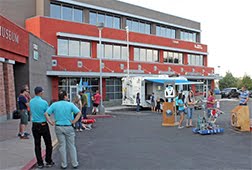
Scenes from Robotics Night at the Bradbury Museum


Robotics Night featured robotics teams from regional schools and local groups with robots used by Los Alamos National Laboratory, Los Alamos Police Department and UMN-LA. The event was brought to the community by the Bradbury Science Museum Association and supported by New Mexico Bank & Trust. (Full story)

Friday, August 23, 2019


Scientists finally know how big earthquakes start: With many smaller ones

Image from the LA Times.

The vast majority of earthquakes we feel come soon after smaller ones, according to new research that provides unprecedented insights into how seismology works.

Sometimes days or even weeks before most temblors of at least magnitude 4.0, scientists have found, smaller ones start rippling beneath the Earth’s surface — activity that can be detected thanks to an advanced computing technique.

“One of the biggest questions in earthquake seismology is how earthquakes get started,” said the study’s lead author, Daniel Trugman, a seismologist at Los Alamos National Laboratory. (Full Story)


Small cluster of earthquakes may be warning sign of larger one to come, researcher says

Daniel Trugman on KGO-TV.

Another day of "Earthquake Roulette" in California and the East Bay, in particular, where the best we can say is that even if the ground didn't t move today, we're still 24 hours closer to the inevitable.

"There has been a long history of seismologists making earthquake predictions and they are generally wrong," said Daniel Trugman at Los Alamos National Laboratory. But he's getting closer and making headlines after publishing a study of quakes in Southern California.

His findings indicate that a flurry of very small quakes, or foreshocks, precede moderate or large ones like the quakes in Ridgecrest this summer. But there's a catch. How do we tell a foreshock? (Full Story)

Also from KPIX-TV and The Daily Dive


Record-breaking lightning as long as Kansas spotted

Map shows the largest lightning flash spotted in the satellite data. LANL image.

One evening while working, Michael Peterson found himself staring at an enormous spider. But Peterson, a remote sensing scientist at Los Alamos National Laboratory, wasn’t looking at a critter of the eight-legged variety. Instead the form crawling across his screen was a monstrous flash of so-called spider lightning—a twisting network of light stretching hundreds of miles across stormy skies. “I was just blown away,” he says. (Full Story)


Zap! Scientists fire laser for NASA's Mars 2020 rover for 1st time

NASA's Mars 2020 rover reached another milestone with the first successful test of its SuperCam instrument.

Researchers at the Los Alamos National Laboratory recently tested the instrument's ability to focus on a target, take a picture, and then record spectra while firing the laser. For the test, researchers used a block of calcite rock and were able to get a nice picture and spectral signals of the calcite minerals, Roger Wiens, principal investigator for the SuperCam instrument, told Space.com. (Full Story)


'Game-changer' for cosmic research

Kilopower reactor, NASA image.

The announcement comes a week after NASA's Future In-Space Operations (FISO) working group pledged that its portable nuclear reactor, called Kilopower Reactor Using Stirling Technology (KRUSTY), will be ready to fly to Mars by 2022.

Earlier, NASA and the Los Alamos National laboratory successfully tested a prototype Kilopower system which will be essential for day-to-day requirements, such as lighting, water and oxygen, and for mission objectives, like running experiments and producing fuel for the long journey home, according to NASA's official website. (Full Story)


A tissue sample from 1966 held traces of early HIV

Image from The Atlantic.

The study is “admirable,” says Bette Korber from Los Alamos National Laboratory, and “the reconstruction of HIV’s emergence and spread is very important.” Korber pioneered such reconstructions: She created the first decent estimate of HIV’s date of origin, using a genetic database that she and others (including Worobey’s team) have repeatedly turned to. She notes that 60 million to 100 million people have been infected with HIV, and 25 million to 50 million have died—a scale of suffering comparable to past world wars. “HIV has left a wound of deepest sorrow across humanity,” she says. “It is part of the human experience. We need to understand it.” (Full Story)


Working Scientist podcast: Switching scientific disciplines

Anna Lappala, LANL photo.

Moving to a new branch of science is scary, but learning new skills and collaborating with different colleagues can be exhilarating, Julie Gould discovers.

In the penultimate episode of this six-part series about physics careers, Julie Gould talks to Anna Lappala, who moved from biochemistry to physics. Lappala, a postdoctoral fellow at Los Alamos National Laboratory, describes how she was initially terrified of people discovering she was not a "real physicist" and worked hard to learn about general physics, quantum field theory, and soft matter, among other things. (Full Story)


Teams compete in LANL’s annual HAZMAT Challenge


LANL's Jeff Dare on KRQE-TV.

First responders are testing their skills in the Los Alamos National Lab’s Annual HAZMAT Challenge.

Ten hazardous materials teams from Nebraska, Tennessee, Oklahoma and New Mexico are participating. The event requires teams to respond to emergencies in aircraft, labs, and confined spaces. They then earn points based on their response.

“Every scenario we put together is real world. We minimize any situations so that teams come out here, they get scenarios, they see every day during their day job,” group leader Jeff Dare said. (Full Story)


National lab details $13B in building plans over next decade

Officials at Los Alamos National Laboratory have plans for $13 billion worth of construction projects over the next decade at the northern New Mexico complex as it prepares to ramp up production of plutonium cores for the nation's nuclear weapons arsenal.

Beyond the new infrastructure related to plutonium assignment, other work likely will be aimed at serving a growing workforce — from planned housing projects and parking garages to a potential new highway that would reduce commute times from Albuquerque and Santa Fe for the 60% of employees who live outside of Los Alamos County. (Full Story)


$500K grant boosts Regional Development Corp. lending program
 

The Española-based Regional Development Corp. will use a $500,000 grant from Los Alamos National Laboratory operator Triad National Security LLC to fund its loan programs to small business, technology and manufacturing firms, plus tribal economic diversity grants.

“This is a very big deal,” Alonzo said. “It can make the difference for someone. A guy had to buy a power nail gun to grow the business. A lot of times rural businesses don’t have an extra $500 or $1,000.” (Full Story)

Also from the New Mexican this week:


The Mexican spotted owl thrives on Los Alamos land


A Mexican spotted owl in Three-mile Canyon at Los Alamos National Laboratory. LANL image.

Mexican spotted owl habitat at the laboratory, like that found in Three-mile Canyon, is protected against loss or alteration, and during the owl’s breeding season, noise disturbances from construction and other activities are prohibited. The precautions the laboratory takes to protect the habitat of these owls sets it apart from other facilities in the United States. The habitat management plan developed in 1999 was novel for its time. This formal agreement between the Department of Energy and the U.S. Fish and Wildlife Service allows the Laboratory to successfully execute its national security mission while protecting wildlife. (Full Story)

To subscribe to Los Alamos Press Highlights, please e-mail listmanager@lanl.gov and include the words subscribe PressHighlights in the body of your email message; to unsubscribe, include unsubscribe PressHighlights.

Please visit us at www.lanl.gov