Climate change could cripple southwestern U.S. forests
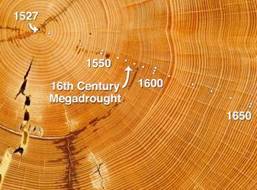
This Douglas-fir sample from the Southwest has annual tree rings dating back to the year 1527. Daniel Griffin.
Combine the tree-ring growth record with historical information, climate records, and computer-model projections of future climate trends, and you get a grim picture for the future of trees in the southwestern United States.
A. Park Williams of Los Alamos National Laboratory in New Mexico is the lead author of the paper, "Temperature as a potent driver of regional forest drought stress and tree mortality." (Full Story)
This story also appeared in Fronteras and the Santa Fe Reporter
Powering Curiosity on Mars — and beyond
A multi-mission radioisotope thermoelectric generator (MMRTG) at NASA’s Kennedy Space Center. NASA photo.
Curiosity, which is significantly larger and at least 10 times heavier than previous Martian rovers, uses a new generation RTG, the “Multi-Mission Radioisotope Thermoelectric Generator (MMRTG),” a device assembled and tested by researchers at Idaho National Laboratory, with components from Los Alamos National Laboratory and Oak Ridge National Laboratory, and assessed for nuclear safety by Sandia National Laboratories.
The device will give the mission on Mars’ surface an operating lifespan of a full Martian year (687 Earth days, a little less than two Earth years) over a wide latitude range. (Full Story)
Geoffrey West finds the physical laws embedded in human cities
Geoffrey West. From Discover.
Early in your career, you co-founded the high-energy physics group at Los Alamos. What was that like?
We had some amazing people there. Many of us played an important role in helping to develop what became known as the Standard Model of physics, which is our best mathematical description of the fundamental forces and particles. And because of the huge computing power at Los Alamos, we worked on simulating the theory on a computer rather than using the traditional analytic mathematical techniques of the time. (Full Story)
Questa couple pursues college degrees thanks to LANL Foundation’s assistance
Santana García-Chang, left, discusses a drainage stabilization field project at Los Alamos National Laboratory with mentor Debbie Apodaca Pesiri. LANL photo.
When Questeña Santana García-Chang saw a video about the Los Alamos National Laboratory’s employee scholarship fund she thought, “I want to be in that.”
García-Chang and Francisco “Kiko” Rael hang out with scientists and engineers at their adopted home in Los Alamos. Their days are busy: caring for 2 1/2-year-old son, Javan, working 25 hours a week at Los Alamos lab, she an intern, he a contractor. (Full Story)
LANL tops records in first year of accelerated shipping
Another TRU waste shipment heads for WIPP. LANL photo.
In the first year of an effort to accelerate shipments of transuranic (TRU) waste to the Waste Isolation Pilot Plant (WIPP), Los Alamos National Laboratory topped its own record with 59 more shipments than planned, and it also became one of the largest shippers of this type of nuclear waste in the country. (Full Story)
Coalition gets $100,000 grant
A coalition of local governments formed to advocate on various issues related to Los Alamos National Laboratory has received a $100,000 grant from the National Nuclear Security Administration’s Los Alamos Site Office. (Full Story)
To subscribe to Los Alamos Report, please e-mail listmanager@lanl.gov and include the words subscribe losalamosreport in the body of your email message; to unscubscribe, include unsubscribe losalamosreport.
Please visit us at www.lanl.gov
And follow us on Facebook, Twitter, YouTube, and Flickr
ChemCam: under the hood
Schematic of the ChemCam system. From Optics.org
ChemCam represents the first implementation of LIBS in a planetary science application, and has already used its laser to study some selected Martian rocks around the vehicle.
Optics.org spoke to the suppliers of three of ChemCam's key operational components, to hear about their initial contact a decade ago with co-developers Los Alamos National Laboratory and the French space research institute CNES, and about the novel technology that resulted. (Full Story)
LANL fetes R&D award winners
Video explains one winning technology - valveless laser processing.
Los Alamos National Laboratory recognized four of its teams that won R&D awards Wednesday night at the Hilltop House Hotel. Lab Director Charlie McMillan handed out the awards to the winners. Other teams that were up for awards also were honored.
“These awards demonstrate the continued success of Los Alamos researchers and partners in defining the frontiers of innovation across a wide range of national security science,” said McMillan. “This innovation and creativity will drive the solutions to tomorrow’s problems.” (Full Story)

Experiment in ULF laboratory corrects prediction in quantum theory
Much of what we know about quantum mechanics is theoretical and tested via computer modeling because quantum systems, like electrons whizzing around the nucleus of an atom, are difficult to pin down for observation.
“It’s nice to know what happens in pure samples, but the real world, is messy and we need to know what the quantum rules are in those situations,” said Vivien Zapf, a staff scientist at the National High Magnetic Field Laboratory at Los Alamos. (Full Story)
Los Alamos National Laboratory marks 20 years without full-scale nuclear testing
The "Divider" test rack is hoisted into position for lowering down hole at the Nevada Test Site in September of 1992. LANL photo.
Two decades ago the last full-scale underground test of a nuclear weapon was conducted by Los Alamos National Laboratory at the Nevada Test Site.
The test, code named “Divider,” was detonated on Sept. 23, 1992 as the last of an eight-test series called “Julin.”
The test had an announced yield less than the equivalent of 20,000 tons of TNT. The purpose of the test, also announced at the time, was “to ensure the safety of U.S. deterrent forces.” (Full Story)
Sounds of ‘alien birds’ in space recorded by NASA spacecraft
Twin satellites of the Radiation Belt Storm Probes Mission. NASA image.
A NASA spacecraft has made the clearest record yet of choruses of noise in the Earth's magnetosphere.
The chirps and whoops were captured by one of NASA’s two recently launched Radiation Belt Storm Probes spacecraft. Collaborators on the EMFISIS experiment include Los Alamos National Laboratory. (Full Story)
Dawn sees hydrated minerals on giant asteroid
DAWN orbiting Vesta. NASA image
NASA's Dawn spacecraft has revealed that the giant asteroid Vesta has its own version of ring around the collar.
One paper describes how the gamma ray and neutron detector (GRaND) found signatures of hydrogen, likely in the form of hydroxyl or water bound to minerals in Vesta’s surface. GRaND was built by Los Alamos National Laboratory. (Full Story)
To subscribe to Los Alamos Report, please e-mail listmanager@lanl.gov and include the words subscribe losalamosreport in the body of your email message; to unscubscribe, include unsubscribe losalamosreport.
Please visit us at www.lanl.gov
And follow us on Facebook, Twitter, YouTube, and Flickr
Forest fires: Burn out
Wild fires dominated the West in 2012. From Nature.
A little after noon on Sunday 26 June 2011, strong winds toppled an aspen tree onto a power line in the Jemez Mountains of northern New Mexico. When a spark from the power line ignited a fire, wind gusts spread the flames into nearby dense stands of fir and pine.
By looking at tree rings, Park Williams of the Los Alamos National Laboratory and his colleagues have been able to assess how droughts stress southwestern forests. (Full Story)
Forests and Climate Change: a Combustible Combination
By looking at tree rings, Park Williams of the Los Alamos National Laboratory and his colleagues have been able to assess how droughts stress southwestern forests. They forecast that if temperatures rise as projected by climate models, trees will face worse drought stress in the first half of the twenty-first century than they have experienced for 1,000 years, probably driving a transformation of the ecosystem. (Full Story)
Experiment corrects prediction in quantum theory
Quantum systems, like electrons whizzing around the nucleus of an atom, are difficult to pin down for observation. One can, however, slow particles down and catch them in the quantum act by subjecting them to extremely cold temperatures.
“Our measurements definitively tested an important prediction about a particularbehavior in a Bose-Einstein Condensate,” said Vivien Zapf, a staff scientist at the National High Magnetic Field Laboratory at Los Alamos. (Full Story)
Small is beautiful: Viewing hydrogen atoms with neutron protein crystallography
Structure of crambin, with main chain amide hydrogen/deuterium exchange pattern ranging from blue (unexchanged) to red (fully exchanged). PNAS image.
Recently scientists at the University of Toledo, Los Alamos National Laboratory and Oak Ridge National Laboratory used neutron crystallography – a technique that even at lower resolutions can locate individual hydrogen atoms. (Full Story)
A step forward for fusion
Ryan McBride watches over the beryllium liner to be imploded by the powerful magnetic field generated by Sandia's Z machine. SNL Photo.
Researchers at the Sandia National Laboratory will announce in a Physical Review Letters paper that magnetized liner inertial fusion, and first proposed 2 years ago, has passed the first of three tests, putting it on track for an attempt at the coveted break-even.
"I am excited about Sandia discovering that magnetized target fusion … is a pathway to significant gain on the Z machine. We agree, and hope that their experiments get a chance to try it out," says Glen Wurden, the magnetized plasma team leader at Los Alamos National Laboratory. (Full Story)
LANL Foundation helps Questa couple pursue degrees
Santana García-Chang, left, discusses a drainage stabilization field project at LANL with mentor Debbie Apodaca Pesiri.
When Questeña Santana García-Chang saw a video about the Los Alamos National Laboratory’s employee scholarship fund she thought, “I want to be in that.” Today she is.
García-Chang and Francisco “Kiko” Rael hang out with scientists and engineers at their adopted home in Los Alamos. Their days are busy: caring for their two-and-a-half-year-old son, Javan, working 25 hours a week as interns at Los Alamos National Laboratory and studying for college classes. But their eyes are on the prize of careers in environmental/civil engineering and health physics for radiation control.
They are both first in their families to pursue college degrees…. (Full Story)
Mousseau to head LANL program
Jeff Mousseau. LANL photo.
Los Alamos National Laboratory announced Tuesday that Jeffrey Mousseau has been hired as the new associate director for Environmental Programs.
Mousseau currently works as a senior project manager for the laboratory’s transuranic waste disposal program. In his new position, he will oversee this program as well as other key environmental cleanup and monitoring activities. (Full Story)
State improves access to LANL data
State environmental officials say they have finished their upgrade to a database that gives thepublic access to information on clean-up efforts at Los Alamos National Laboratory. (Full Story)
New smart grid unveiled at LANL
An electric grid at Los Alamos National Lab just got smarter. It has been upgraded to a $52 millionstate-of-the-art smart grid and it was powered up Monday.
Everything will be managed through an automated command center to instantly switch back and forth among solar, battery backup and other electric power supplies.
Los Alamos County, LANL and a tech company in Japan all worked on the project. (Full Story)
Kyocera, laboratories launch U.S.-Japan smart grid project
Kyocera Corp. and a number of other companies, research institutes and local governments involved announced the start of operations of an international smart-grid demonstration project in Los Alamos, New Mexico.
The project is a collaborative effort between NEDO, the New Mexico state government, the Los Alamos Department of Public Utilities, and the Los Alamos National Laboratory — a national research center which is run under the umbrella of the U.S. Department of Energy. (Full Story)
Air Force continues advanced surveillance aircraft funding in Afghanistan
Angel Fire sensor and software provide enhanced resolution sufficient to identify individuals on the ground. LANL image.
The Marine Corps said Angel Fire, jointly developed by the Air Force Research Laboratory and Los Alamos National Laboratory, is “superior to current unmanned aerial systems in that a typical UAS [collects images of] a relatively small, constantly changing area as the air vehicle moves. [Angel Fire] provides a larger, persistent, geo-rectified image with archival capability.” (Full Story)
To subscribe to Los Alamos Report, please e-mail listmanager@lanl.gov and include the words subscribe losalamosreport in the body of your email message; to unscubscribe, include unsubscribe losalamosreport.
Please visit us at www.lanl.gov
And follow us on Facebook, Twitter, YouTube, and Flickr
N.M. scientists explore Mars from California
ChemCam Operations Center at JPL. LANL photo.
From the fourth floor of NASA’s Jet Propulsion Laboratory, a group of New Mexicans spends much of each “Mars day” managing what is arguably the most important part of the Curiosity rover.
On a perfectly sunny California day last week, two of those New Mexicans — the University of New Mexico’s Horton Newsom and Los Alamos National Laboratory’s Roger Wiens — showed off their workspace. It’s a windowless room lined with computers and pictures of Mars. For them, what’s important is when the sun is shining on the Red Planet, not on Earth. (Full Story)
Today on Mars: Curiosity is all set to sift sand and bake rocks
This image shows the entrance to the CheMin instrument. NASA
CheMin (for Chemistry and Mineralogy), which will sift Martian dirt so it can be X-rayed. CheMin will identify minerals by examining the diffraction patterns of X-rays that pass through the spaces between atoms.
A battery of tests checking out the Mars rover Curiosity should wrap up today, and she's passing them all with flying colors. Very soon, the rover will start doing what it was sent to Mars to do: Swallowing some soil, baking it and X-raying it, with the goal of finding out whether life could ever have survived on the planet. (Full Story)
New RBSP instrument telemetry provides 'textbook' excitement
The Relativistic Electron Proton Telescope. NASA.
NASA’s Radiation Belt Storm Probe’s Energetic Particle, Composition, and Thermal Plasma Suite (ECT) instruments are controlled from an operations center at the Los Alamos National Laboratory.
"Confirm, we're seeing telemetry,” giving ECT principal investigator Harlan Spence of the University of New Hampshire and the ECT team live data of the particles in the belts from two spacecraft, neverbefore gathered within the radiation belts, just three days after launch. (Full Story)
Safer explosives still pack a punch
A unit cell of a cocrystal of HMX (blue), from C&EN
Three new explosives have attractive properties making some of them possible candidates to replace current military explosive favorites, the nitramines RDX and HMX.
Although RDX and HMX are superior to early explosives they are highly toxic and difficult and expensive to make. David E. Chavez, an explosives chemist at Los Alamos National Laboratory, says all three groups’ approaches hold promise to overcome such limitations. (Full Story)

LANL to work on vehicle efficiency
Researchers at Los Alamos National Laboratory will be working on improving vehicle efficiency thanks to a $1.2million grant. The funding was awarded through the Office of Energy Efficiency and Renewable Energy’s Vehicles Technology program.
U.S. Rep. Ben Ray Lujan’s office says the program is investing in three new projects that focus on increasing the efficiency of engines and powertrain systems for future vehicles. The research will also be funded by $300,000 in private investment. (Full Story)
LANL Study’s Tree Death Climate Change Connection

Click on the picture to see the LANL YouTube video.
What are the exact physiological mechanisms that lead to tree death during prolonged drought and rising temperatures? These are the questions that scientists are trying to answer in a Los Alamos National Laboratory research project called SUMO.
SUMO stands for SUrvival/MOrtality study; it's a plot of land on the Lab's southern border that features 18 climate controlled tree study chambers and a large drought structure that limits rain and snowfall. (Full Story)
Also from the Daily Post this week:
LANB hosts United Way 2013 campaign kick off
A large crowd filled the lobby of Los Alamos National Bank Wednesday evening for the United Way of Northern New Mexico's annual kick off campaign.
United Way Executive Director Kristy Ortega recognized Debbi Wersonick, Carol Rutten and Linda Anderman of Los Alamos National Laboratory's Community Programs Office. (Full Story)
To subscribe to Los Alamos Report, please e-mail listmanager@lanl.gov and include the words subscribe losalamosreport in the body of your email message; to unscubscribe, include unsubscribe losalamosreport.
Please visit us at www.lanl.gov
And follow us on Facebook, Twitter, YouTube, and Flickr!